Drought? What Drought?
Written by Brian Bushard
Photo by Kit Noble
Easy Street was flooding in a foot of water, just like it had hundreds of times before and will hundreds of times again. Three inches of rain had just drenched Nantucket over a three-day September nor’easter, capping off a wetterthan-average summer and early fall. And still, despite three months of steady rainfall, the island remained in a “significant” drought, according to the state agency that controls Nantucket’s water supply.
With so much rain, it’s baffling to Wannacomet Water Company director Mark Willett that Nantucket remains in a so-called level-two drought, requiring property owners to continue to limit outside water use. “I have lost what little faith and trust I had in the Massachusetts Drought Management Task Force,” Willett told the Nantucket Current. (Nantucket was placed in a level-one drought after this issue of N Magazine went to press.)
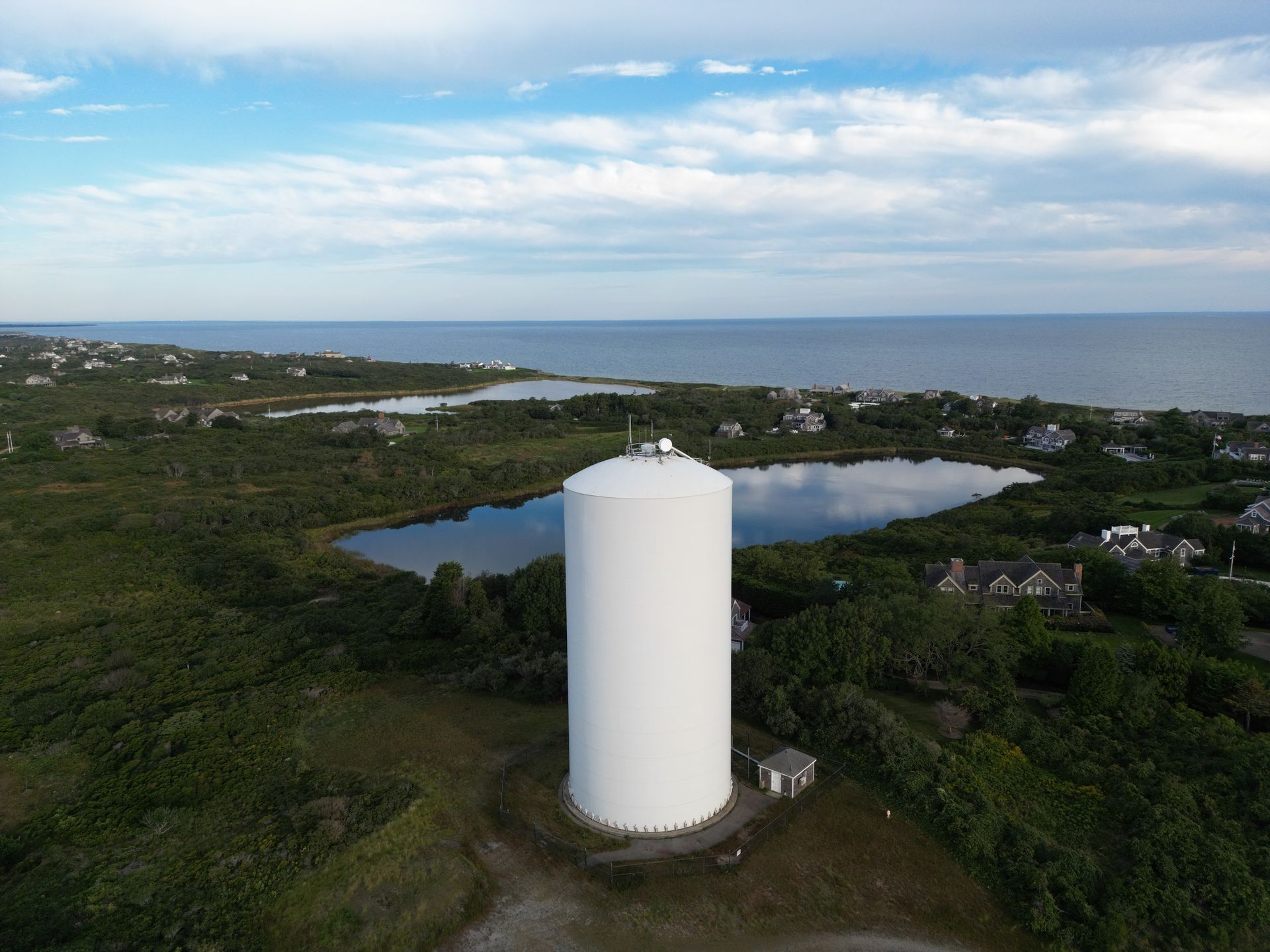
From July to September, Nantucket received 11.4 inches of rain, nearly as much precipitation as it had over the previous nine months combined. The town’s water tanks are full, while underground, Willett said there’s so much fresh water that the aquifer extends over 100 feet above the depths where Wannacomet pumps its water—and that’s not counting the water below where the pumps reach. “That’s 100 feet of water times the area of Nantucket,” Willett said. “I can’t do that math in my head. That’s billions of gallons of water.”
The aquifer is so massive that researchers in the 1980s discovered fresh water as deep as 1,100 feet below the surface. Last year, a team of scientists stationed 20 miles south of Nantucket discovered fresh water with a salinity rate of only two parts per thousand. They even found fresh water 43 miles offshore, with only a slightly higher salinity rate.
The drought becomes even more perplexing when you look to Martha’s Vineyard, where a rainy summer lifted the island completely out of a drought. That means that less than 15 miles away, homeowners, landscapers, pool companies and businesses are no longer restricted in their outside water usage, while on Nantucket, they can face fines for irrigating their lawns. In fact, most of Worcester and Berkshire counties have joined Martha’s Vineyard out of a drought designation, while only Nantucket and the Cape remain in a “significant” drought.
But the answer might be a bit more complicated. RJ Turcotte, an ecologist and waterkeeper with the Nantucket Land & Water Council, compares Nantucket’s water supply to a “bank account” of underground fresh water. The principal deposit was made by the Laurentide ice sheet during the last ice age thousands of years ago. The account is replenished every time it rains. “As our population has grown, we have continued to skim the top to pay for our lifestyle,” Turcotte said. “However, now our seasonal population has multiplied 20-fold, and it isn’t raining as much in recent years as it did in the past, so we're officially at risk of dipping into the principal. Groundwater is retreating farther from the surface. Those who live near one of the little ponds like Crosby or Quaise or Pout, which have gone dry, can see this with their own eyes.”
Danielle O'Dell, director of research at the Nantucket Conservation Foundation, has also seen the effects of a protracted drought across the island. “Some of the ponds in the Middle Moors are completely bone dry, and have been increasingly getting that way over the last few years,” she said. “Even with additional rain, it just soaks right up [in the soil], so it makes little difference. We’re so far behind. People think this rain is helping. Well, we need a couple years of good rain to get things back to normal."
Nantucket’s aquifer is owned by the state. The ultimate decision to place the island in drought status comes down to the Massachusetts Department of Environmental Protection. On Nantucket, that decision is based on the water level in a well off Russell’s Way that’s monitored by the U.S. Geological Survey. And as it turns out, the water level in that well has trended downward for the past five years, while for nearly two years, it has sat below the threshold to trigger a drought.
“It’s frustrating that people complain about not being able to water their green lawns, but the implications for plants and wildlife aren’t being considered and are being brushed under the rug, and it’s so obvious,” O’Dell said. “You stand by the Pout Ponds and see a completely dry pond.”
If it were up to Willett, the drought would be over, or at least dropped to a level-one status, which carries more lenient watering restrictions. While the well off Russell’s Way still falls below the state’s threshold, another well in Madaket has responded better to the recent rain. With that disparity in water levels between two wells on the island, Willett argues the state should make its decisions based on multiple wells, taking the average between them. “We’re just asking them to take a scientific approach,” he said. “It’s not very scientific to just take one dot and say, ‘This is it for everything.’”
“If we averaged some of the wells we wanted to average, we would still be in a drought condition, but it would be at level one,” he added. “So people would be allowed to irrigate certain days of the week, and people would be allowed to use more water outside than they currently do. It wouldn’t get us completely out of the drought, but we would be at a much more comfortable place with drought conditions where people can actually work. Irrigation guys could work, and landscapers could work, and pool guys could fill pools. We would be in a much better place.”
As a result of the ongoing drought, the Wannacomet Water Company has pumped 100 million fewer gallons this summer compared to last summer. Since Wannacomet serves as an enterprise fund for the town, it generates revenue from pumping and selling water, and from connecting new properties to town water. With 100 million fewer gallons pumped this year, that means its revenue has dropped. Willett is now holding off on replacing some of the water company’s older equipment, as he had planned, until his revenue rebounds.
And as for water usage restrictions, Willett has not fined a single property owner or landscaper who has violated state-imposed water restrictions. Instead, he’s been working with property owners to reduce the amount of water they use. “I’m at the point now where I don’t think it’s fair to tell someone who has invested millions of dollars in their home on Nantucket and who has put tons of money into their landscaping [not to water their lawn],” he said. “I know when I do my annual report and I submit the data to the [state] DEP, there may be questions from them, and I’m just going to try to be honest with them and say I was trying to work with our customers and work with the companies and work with people to keep the island moving."
Latest Stories