Hunting for a Permanent Solution
How to Combat Nantucket's Tick Problem
Written by Jonathan Soroff
The old aphorism “No good deed goes unpunished” is true, at least as far as Nantucket’s burgeoning problem with deer and the tick-borne illnesses they spread is concerned. When English settlers arrived on the island in 1659, there were no deer. Fast-forward to 1922, when fishermen found a buck struggling in Nantucket Sound and brought him to the island. Four years later, an islander imported two females as solace for the lone stag. Today, the island’s white-tailed deer population is estimated to be 7,500 or more. According to Dr. Martin Feehan, Deer and Moose specialist for the Massachusetts Division of Fisheries and Wildlife, the healthy density for a deer population is 12-18 per square mile. “Nantucket has 70-80, and in some places, more than 100.”
Compounding the problem is the fact that over half of the island is preserved as conservation land, which provides a perfect habitat for the deer and mice that ticks rely on for their “blood meals.” If left unchecked, the deer population on Nantucket could soar, according to some mathematical models.
Add to that alpha-gal syndrome, the potentially life-altering malady that can make its human victims allergic to red meat and most dairy products. With alpha-gal, the culprit is the lone star tick, which was first recorded on the island in 2019 and has since spread across the entire island. In 2025, there were only seven positive tests of alpha-gal recorded at Nantucket Cottage Hospital, but that number has swelled to 80. If that’s not enough to make your skin crawl, Tucker Taylor of the Nantucket Conservation Foundation pointed out that each lone star tick can lay more than 2,000 eggs, roughly twice as many as black-legged ticks.
While Lyme disease can be treated with antibiotics, alpha gal is currently untreatable, and if a person is bitten and infected, within half an hour, that victim could ultimately be unable to process meat or any by-product from hoofed animals. “It’s the way the individual’s body reacts to exposure, and everyone reacts differently,” Taylor said. “There’s no antibiotic or treatment, no systematic diagnostics.” It is unclear whether the allergic reaction to meat products is a lifelong condition, however, once a person is positive with alpha-gal, it is expected that the negative reaction to any product produced by a hoofed animal can last at least several years and possibly for a lifetime.
The first and most obvious way to try to reduce the deer herd is through hunting. Some efforts to reduce the deer population appear to have worked so far. In the 2025-2026 hunting season, a record 1,003 deer were killed, and in an expanded early season over the last week of September 2026 alone, hunters took another 73 deer. Hunters on the island have and will continue to play an important role in reducing the growth of the herd, but in order to significantly thin the population of deer on Nantucket, more comprehensive approaches are needed.
This year, islander Mike Leavitt, along with the Nantucket Land Bank, Nantucket Conservation Foundation and N Magazine publisher Bruce A. Percelay banded together to more significantly reduce the deer population. The group is asking islanders to buy in to reducing the deer population via deer donation and deer damage permits from the state government. These permits give greater latitude on methods of managing the deer population. Those include extending the hunting season, the use of (otherwise illegal) baiting and rifle silencers, and expanding the capacity of Nantucket Community Food Hub’s deer meat processing facility, operated jointly by the Land Bank and Nourish Nantucket.
Select board member Bobby DeCosta believes that hunting is the only practical solution to reduce the deer population, and because so many of the animals congregate on private property, he believes the effort will require the majority of landowners to allow hunters on their properties—though he acknowledges that might not be a realistic expectation. Widespread professional hunting initiatives could also be thwarted by the inability to isolate large numbers of deer, according to DeCosta. That said, there are many who feel a large-scale approach is the only possible solution to meaningfully reduce the herd.
“Any large-scale plan for the reduction of the herd would need to be supported by the town and the local hunting community, and before we undertake any specific action, we will want full buy-in from elected town officials,” NCF president Cormac Collier said.
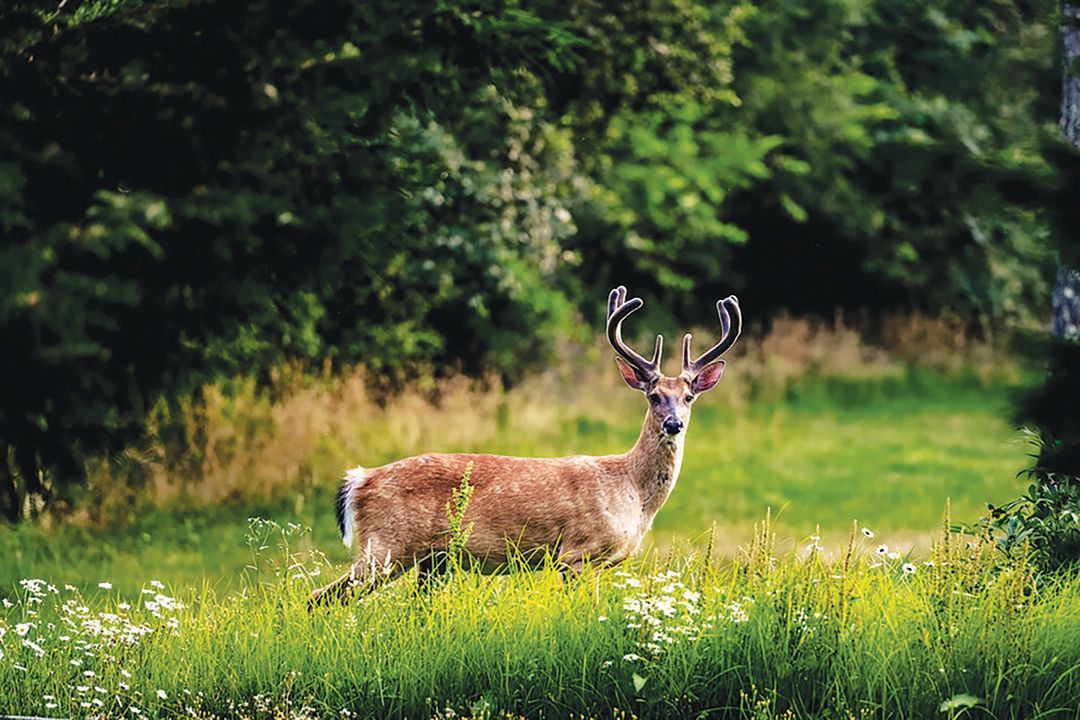
While these efforts may well increase the number of deer killed during the hunting season, they will not solve the long-term problem. While the hunting season is essential to slow down the growth, the question still remains as to how to reduce the core population of deer on the island. The ultimate and perhaps only solution to make a deep reduction in the deer population might just come through the use of professional sharp shooters, a bold effort that has proven effective in other communities.
On Catalina Island in California, officials approved a plan to eradicate the island’s population of mule deer in order to stave off the destruction of the island’s native ecosystem. Under the plan, professional hunters have been tapped to shoot the estimated population of 2,000 non-native deer. While the plan received pushback from the public, including an online petition with more than 32,000 signatures and a preliminary injunction to stop the project, a county judge ultimately allowed the killing to proceed, starting with several hundred deer this fall.
On Martha’s Vineyard, some residents have considered hiring a Connecticut-based company called White Buffalo to eliminate the deer population on the island through sharpshooting. The Vineyard has suffered a large-scale outbreak of alpha-gal with an estimated 1,200 reported positive tests, creating not only a health crisis but a potential threat to its economy through the reduction of tourism. A second alternative is to bring in the United States Department of Agriculture, which also has sharpshooting teams that are designed for deer herd mitigation. The USDA has certain latitude that private firms do not, including the ability to hunt deer out of vehicles and with the use of silencers so that a single shot does not spread the herd.
A likely plan for Nantucket for large-scale culling of the herd would be first to identify more accurately many deer are actually on the island, through a drone survey using infrared technology. That type of survey is typically conducted in the winter for the highest heat contrast to produce the most accurate results. Once it is determined where the deer are, the professional sharp shooters would develop a strategy as to where they would be most likely to begin their hunting program, and herd the deer to locations that concentrate them for more effective elimination.
A common misconception is that eliminating the deer population in its entirety is simply a choice. The fact is, it is a complex problem that involves private property rights, following deer migration patterns, disposal issues, tracking deer on an island with 55% conservation land, and cost. Despite the enormity and complexity of the problem, according to Percelay, “We have little choice but to take whatever steps necessary to once and for all solve this problem before it becomes actually unsolvable. We do not want to have the same impact as has been experienced by the Vineyard and the time to act is now.”
Major landowners on the island, including the Land Bank and the Nantucket Conservation Foundation, are on board with the idea to reduce the herd. “The overpopulation of deer and the fear of the lone star tick could ultimately impact people’s choices regarding recreation on our property,” Land Bank executive director Rachael Freeman said. “Working in cooperation with the other major land management groups on Nantucket is an essential part of solving this growing problem.”
Latest Stories