Resurrecting a Ghost Sign
The faded Petticoat Row sign gets a new life on Centre Street.
Written by Mary Bergman
Photography by Kit Noble and courtesy of the Nantucket Historical Association
At the corner of Centre Street and Main Street, on the bricks of the Congdon & Coleman building, you can just make out a faded handwritten sign in black and white. PETTICOAT ROW, the sign once proudly declared. For decades now, this faded sign has merely whispered. Petticoat Row, as Centre Street was called for generations, was once home to many women-owned or operated businesses.
A romantic myth about Petticoat Row persists—that women ran businesses there while their whaling captain husbands, brothers and sons were away at sea, following sperm whales all points south. This is the stuff of widow’s walks and cobblestones being used as ballast in whaleships. Women did operate businesses across the island—many in their own homes—during the whaling industry and throughout the 19th century. But Petticoat Row’s stretch of women-run shops took shape in the post-Civil War era, after the decline of the whaling industry, as more and more women needed to earn a living outside the home.
In 1923, the last of the old-time merchants of Petticoat Row, Miss Hannah G. Sheffield, died. A news item in The Inquirer and Mirror at the time announcing her death noted, “Verily, times have changed, and the character of ‘Petticoat Row’ has changed more than any other street in town. It will henceforth be only a memory.”
But in 1935, just 12 years after Sheffield’s death, there was an appetite on the island to enshrine Petticoat Row in memory. The Selectmen were petitioned to place a sign at the corner of Centre and Main, and another at the corner of Centre and India (then called Pearl Street) to name the block Petticoat Row.
The sign on Centre and Main was painted by 1941, but how long it was maintained remains a mystery, while the India and Centre sign was lost to time. A 1973 effort to officially rename Centre Street to Petticoat Row was defeated by the Selectmen at the time. Those who opposed the measure were concerned that changing a street name would create too much confusion for residents, especially when it came to where their credit card statements would be mailed.
Last spring, island real estate agent Shelly Lockwood, whose offices are situated on the former Petticoat Row, took stock of the faded sign on the Congdon & Coleman building and decided she wanted to see it restored to its former glory. Lockwood dove into research at the archives of the Nantucket Historical Association and found an image of how the sign appeared in its heyday. Next, she approached Jim Congdon, co-owner of the building on which the sign is painted, about restoring the sign. Congdon was supportive of the idea. But this being Nantucket, Lockwood had to first get permission from the Historic District Commission and Sign Advisory Council to repaint the existing sign. It was perhaps an odd catch—that a sign that has existed for at least 89 years needed permission to be repainted—but Nantucket does things its own way. The faded Petticoat Row sign had surrendered to the weather and the passage of time.

Throughout the country, these “ghost signs” pop up all over, usually as faded advertisements in urban environments on brick buildings. Signs painted on bricks were less expensive than signs made of wood, and people on Nantucket during the Great Depression (like the rest of the country) would have been looking for ways to save money. Sign painting was dangerous work, as sign painters had to be up very high.
Preservationists are often split on what to do about ghost signs. They are ephemeral objects; they were not made to last forever. Should they be documented and photographed and then left to fade away? Or should they be restored and revived, given a new life? Painting the Petticoat Row sign is more than just making it look nice; it is a way of making sure women’s history does not fade from memory either. In a moment where women’s contributions to this country, and women’s rights, are under siege, reminding the island and all who visit that this island has always been a place where women were able to own and run businesses is important.
“Working women were highly esteemed within the community,” Jascin Leonardo Finger, a curator and deputy director at the Maria Mitchell Association, wrote in her master’s thesis, The Daring Daughters of Nantucket Island. The Daring Daughters of Nantucket Island explains that while women did work in other towns and cities across the country, women on Nantucket made decisions about finances that impacted not just their families but the island’s economy. As Nantucket occupied such an important place in the global economy at the height of the whaling industry, the island was a place where women’s contributions had an impact on more than just this little sliver of sand. According to Finger’s research, there were at least 100 businesses on the island owned by women in the 19th century.
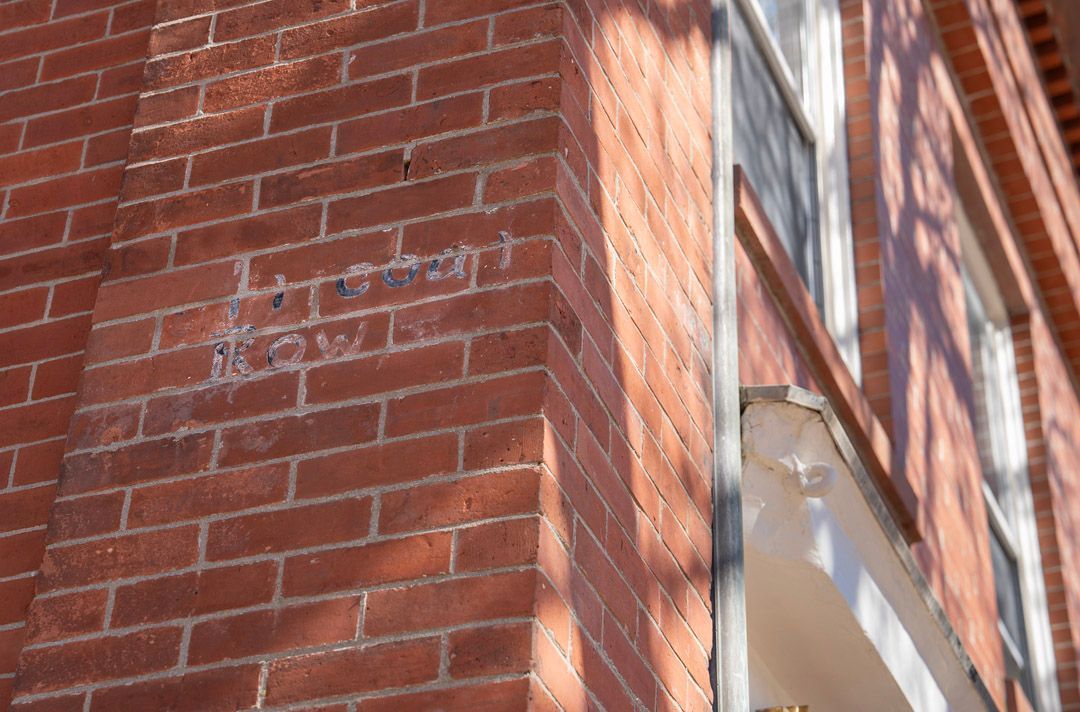
This summer, Congdon & Coleman reached out to island artist Penn Austin to repaint the faded sign, bringing attention to the ghost sign and to the history of Petticoat Row. Will this new sign fade away, too? Maybe, in time, it will take on a similar patina to the old sign.
Paint does not do well here, at the mercy of the wind, waves and salt spray. Not everything was made to survive the weather. It takes a lot of work to make it feel like not much changes on Nantucket. Even if the sign does fade away, the contributions of women to this island, and this country, will not.

Latest Stories