A Purdy Picture
Written by Larry Lindner
Photography by Kit Noble
The Artists Association of Nantucket
Honors Jan Purdy Metcalf
Like many people who make Nantucket their home, Jan Purdy Metcalf's path to the island was circuitous. It was 1997, and Metcalf was renting a cottage on Hummock Pond where every day some 30 geese waited for a retired game warden to come feed them. She could hear his motorcycle zooming down Hummock Pond Road. Born from that recurring tableau was the first painting Metcalf ever sold—a scene of the geese by the pond—and her second marriage—to the game warden.
Now, almost 30 years later, she will be celebrated as the honoree at the annual gala of the Artists Association of Nantucket (AAN), which takes place on Saturday, July 18, at the Great Harbor Yacht Club. “She was an obvious choice,” said AAN Executive Director Tracey Sears. “She’s always one of our top sellers. And she’s always one of the first to help other artists or to volunteer.”
Metcalf has been coming to Nantucket since 1968, although it was an inauspicious beginning. She was flying in from Detroit to visit her boyfriend but missed her connecting flight to the island. Fortunately, a man at Logan Airport with his own plane saw her and took pity on the crying teenager, whisking her to Nantucket for $12. When she reached town, with a coiffed hairdo and in “a really cute dress and heels,” she saw that “everybody had long hair and wore blue jeans.”
“It was the start of a really wonderful relationship with the island,” Metcalf said. She and her boyfriend came back to Nantucket every year, married after a time, and then came back annually with their two daughters. In the early days, she said, “I did a little gardening for 50 cents an hour. Then I got a job as a waitress at the Sweet Shop, which is now Or, The Whale.”
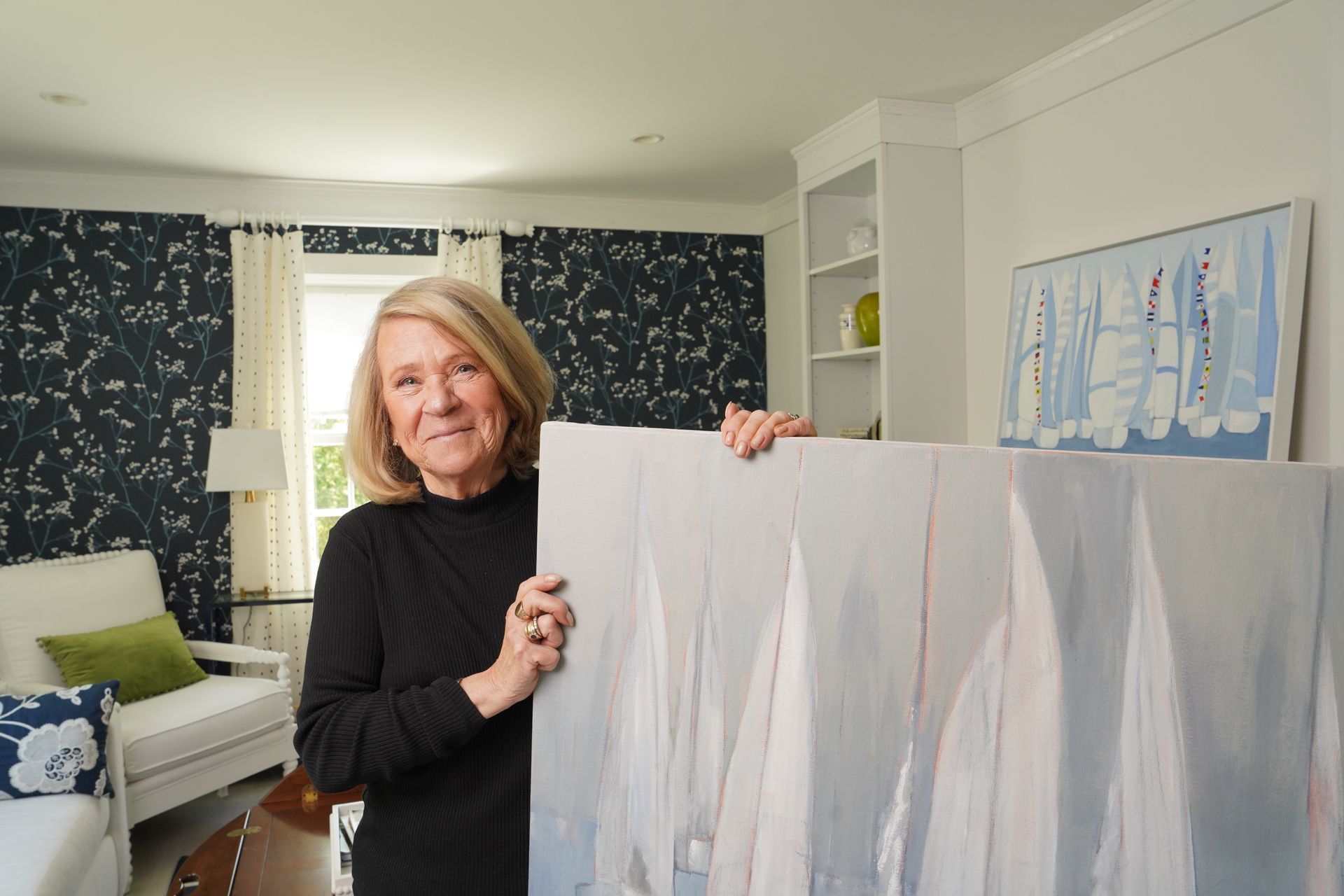
She moved to the island fulltime when she married the game warden, Eddie Metcalf. “It wasn’t like I was going to restaurants all the time,” she said. “And my family had grown up. I needed a network. I needed to find my tribe.” She found it at AAN, not a stretch since she had already spent decades on the mainland as an artist, painting wall-size murals in children’s rooms as well as working in interior design.
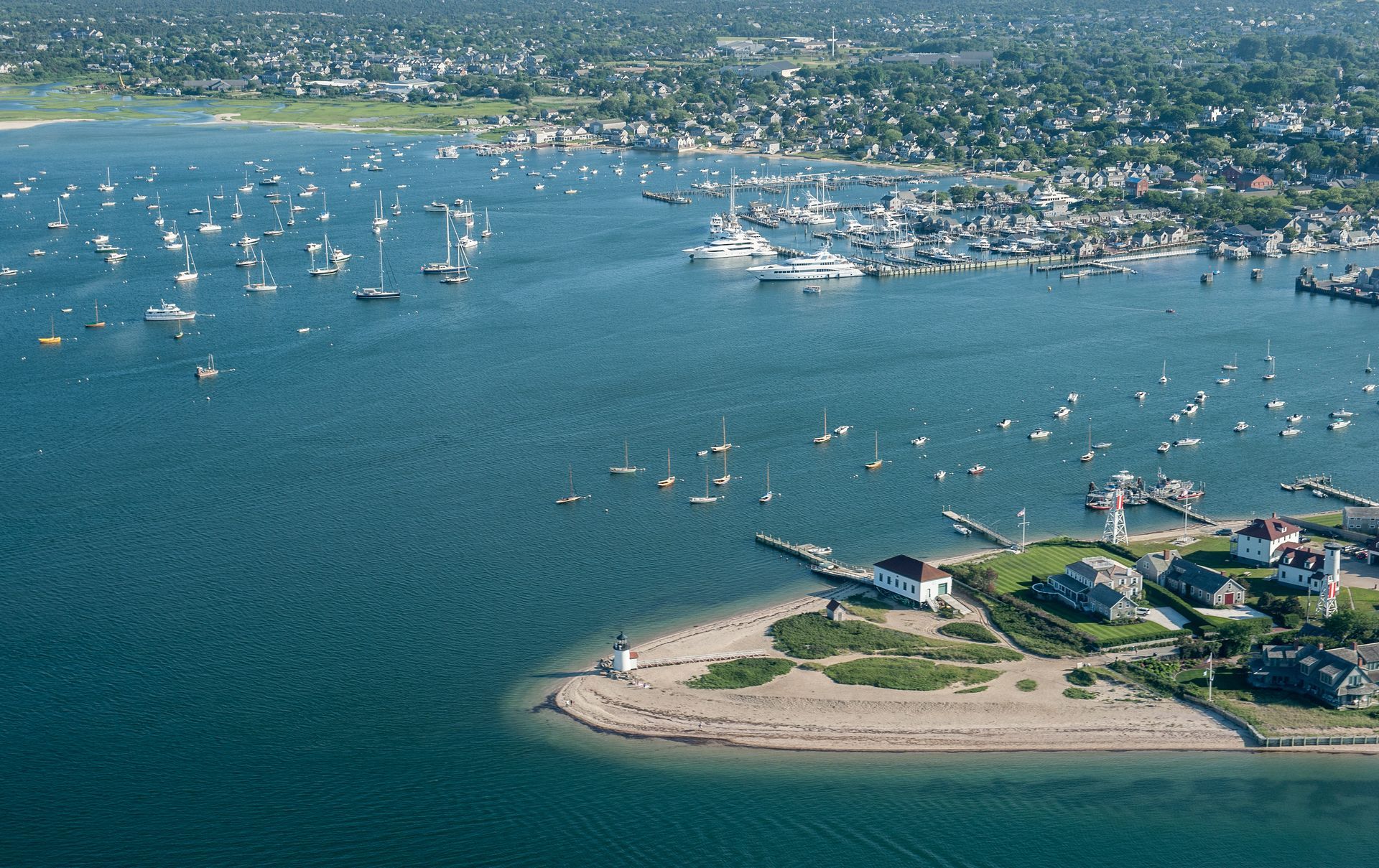
Many of her works center on sailboats, which is one reason the theme of this year’s gala will be a nautical “Raise the Sails.” Metcalf has been sailing since she was a girl in Michigan, and she taught sailing for a while, too. “The confusion of a race’s start or finish is kind of what I want to capture,” she said about her art. “It’s a mess, lots of boats going this way or that way, but really beautiful to see them all together.” She has seen it, of course, at the Opera House Regatta and also in the Bahamas, where she wintered for years with Eddie and had a close-up view of sailboat races from her front door.
Along with the boats, there are paintings of waterside shanties, flowers and other motifs, notably, the one covered in her Little Black Dress series. “I once saw a picture in The New York Times of the inside of the Metropolitan Museum of Art,” Metcalf said. “All of the women [in the photo] were dressed in black—very New York—but two of the women weren’t looking at the paintings. They were looking at their reflections in the mirror. I thought that was so interesting.”
She also likes to paint what she called “a fair amount of old Nantucket, the houses I remember from when I first came—in areas like Madaket, and the little houses by Hummock Pond. ”Her works often have something geometrical and still at the center—a boat, a dress, figures in bathing suits—but movement around them in the form of water, sky or both. As far as genre, “she’s a contemporary artist,” said AAN Artistic Director Robert Frazier. She uses “thicker paint that’s a bit blockier than a watercolor—loose, chunky, but very appealing,” he continued. And yet “at the same time a lot of her art resembles [the simplicity of] folk art, although not naive or childlike like classical folk art, which is usually from an untrained artist.”
Her Little Black Dress paintings, like her others, are “very simply done in some way but with a very appealing, contemporary look—ladies in black dresses at parties, ladies in bathing suits at the beach, a row of three or four dresses on a rack,” Frazier said. Similarly, he noted that her interpretation of “a lot of vertical masts all bunched up has a very modern feel but, at the same time, a sort of simple older character to it."
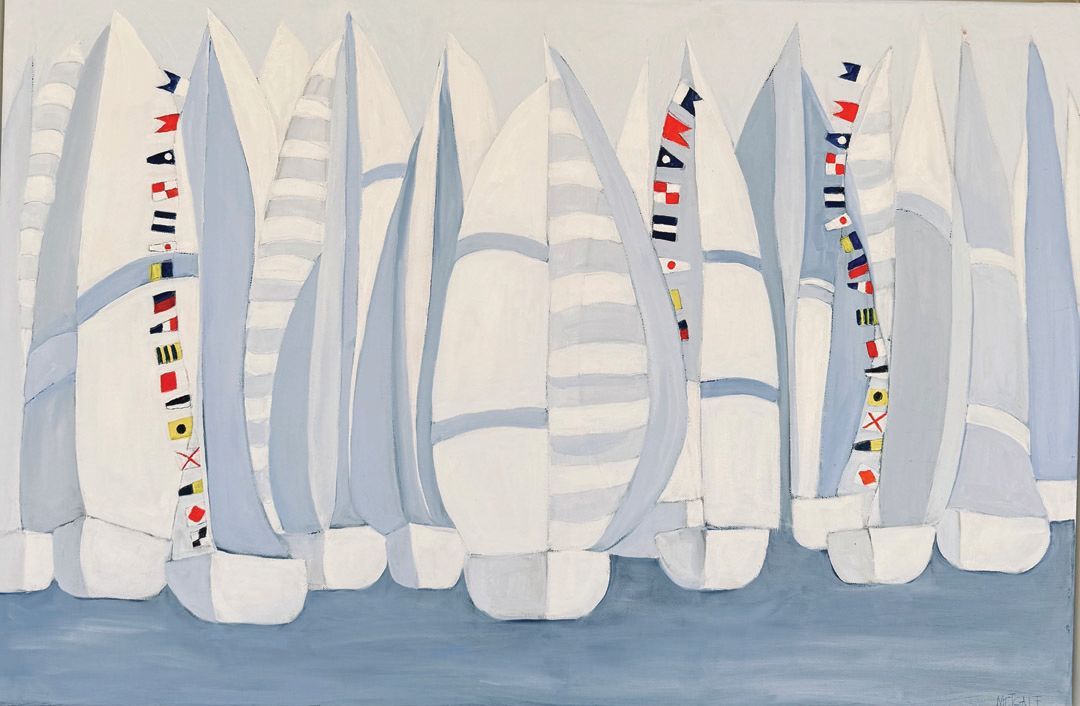
It works. “For quite a few years now, Jan has been one of the top 10 sellers at the Artists Association,” said Miranda Holmes, director of the AAN’s Cecelia Joyce & Seward Johnson Gallery. “Not everyone on Nantucket collects Nantucket art. Some people don’t want a lighthouse. But Jan’s work fills the spectrum.”
“She’s got a big price range,” Holmes added. “You can collect her at $200, you can collect her at $3,000. Jan allows any level of buyer, and it’s nice to be able to say that you own a piece of her artwork.” But it’s not just Metcalf’s art that Holmes, Frazier and Sears appreciate. It’s also the way she throws herself into the AAN community. Metcalf shies away from the accolades, so much so that when Sears and AAN board president, Laurie Champion, called her to say they wanted to name her this year’s honoree, she said she had to think about it overnight.
That didn’t sit well with Metcalf’s daughter, who was there at the time. “I’ll call back and say you’re going to do it,” the daughter said. Metcalf has since let herself lean into the recognition, if only a little. “It’s such an honor,” she said, “an incredible honor.” But she’s more comfortable talking about the sense of belonging that AAN has afforded her. “I want to emphasize that [being part of AAN] is really fun. I’ve made all sorts of friends. It’s just been so gratifying to have such a large group of people.”
Holmes still goes back to her talent. “We have a lot of notable names at AAN,” she said, “early 20th-century artists going right up into the ’60s, ’70s and ’80s—names that are still very collected, highlighted on this island. I see Jan being that person 20 years from now, being one of those highlights of this time, if she’s not still creating art at that point. She’s going to have that level of collectability. You look at her artwork, you know it’s hers. You don’t need to look for her signature. It’s very much her stroke, her vibrant colors. From her little black dresses to the regatta images, it’s all subject matter she’s extraordinary with.”
Latest Stories