It's A Grind
The Restoration of the Old Mill
Written by Brian Bushard
Photography by Kit Noble
It is to Nantucket as the Mayflower is to Plymouth, the Public Garden is to Boston and the Liberty Bell is to Philadelphia. The Old Mill on Prospect Street is an inseparable part of Nantucket’s identity, yet for the past two years, it has been shrouded in tar paper with its blades removed and doors closed to visitors.
Erected in 1746, when Massachusetts was still a colony, it is believed to be the oldest functioning grist mill in America. The windmill has stood the test of time and at various moments in history, was actually considered for demolition were it not for voices of preservation over the years. As important a landmark as the mill is, why does it seem so painfully slow to restore it, which has not seen a kernel of corn ground in nearly 700 days?
Like many restoration projects, there is more to restoring this mill than meets the eye. When the Nantucket Historical Association set out to restore the building two years ago, they uncovered mysteries that they were not expecting, forcing them to embark on the biggest restoration of the mill in its 280-year history. “We wanted to do a restoration project that is right for this building and right for the island and right for the history of this place,” Parker added. “We’re doing it with the right materials and the right processes with the right people involved, however the complexity of this renovation goes far deeper than we had imagined."
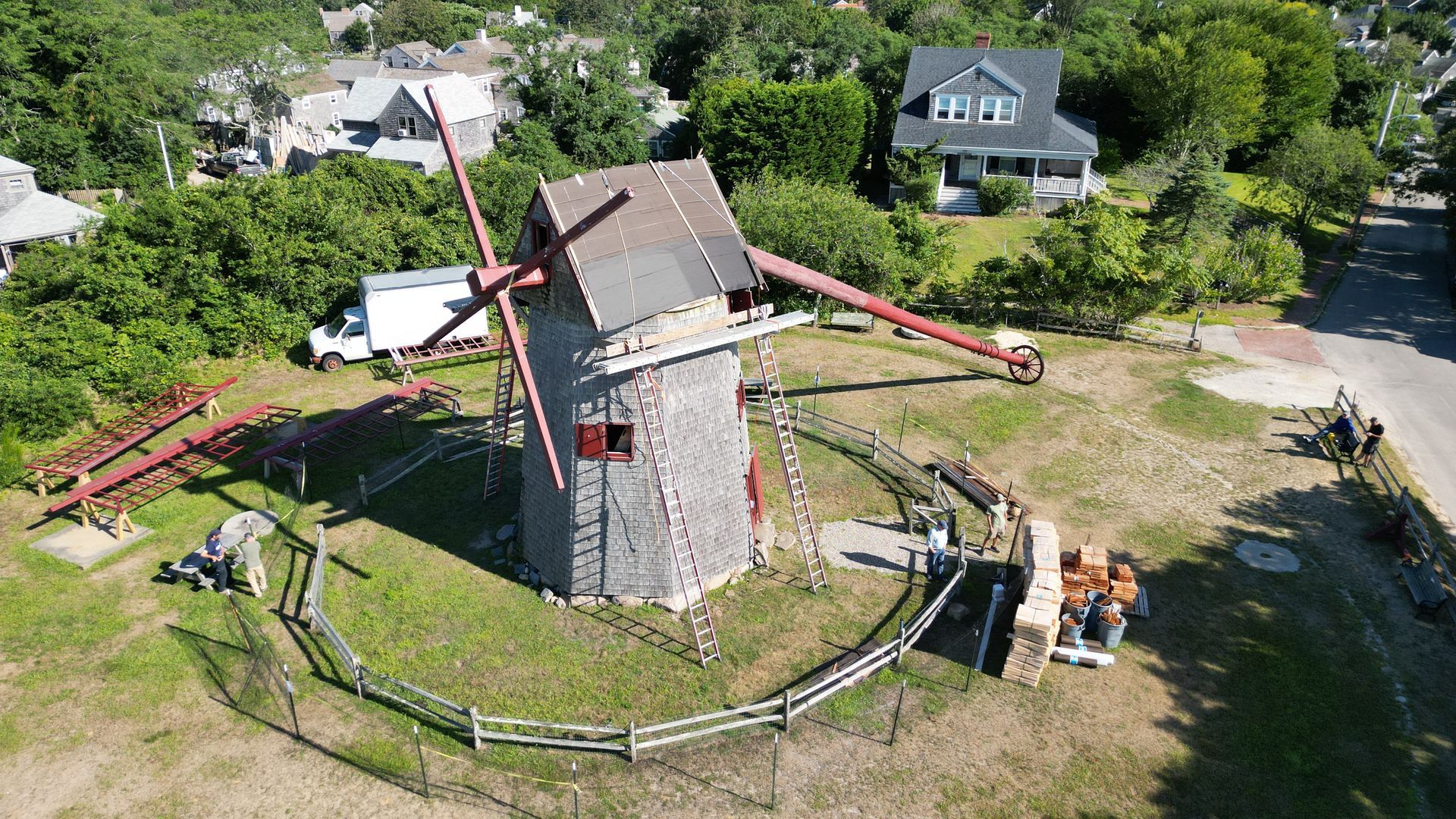
For two years, the historic structure has stuck out like a sore thumb to drivers on Prospect Street. What started as a “fast-paced,” simple structural renovation and reinforcement has become a multiyear operation. Last year, the NHA consulted Husk Preservation Inc and started a project to study the property, down to its granite inner mechanism, to determine the scope of the work necessary.On the outside, it looks like any old renovation, with its shingles stripped and chain-link fencing lining the perimeter of the property.
Inside, however, Husk and the NHA are studying the date of the timber through a scientific dating process called dendrochronology, as well as the moisture, rot and movement of the building. The goal is to retain as much historic material as possible, and when not possible, honor the original workmanship by replacing hewn wood with hewn wood, or beveled white oak with beveled white oak, according to Husk Preservation President Amy Boyce. As a smock mill, the octagonal tower spins only on its rotating cap, with a beam connecting to a wheel on the ground allowing operators to rotate the sails in the direction of the wind.
The NHA has installed moisture sensors throughout the building, a groundwater sensor underneath the building, and, once it’s ready, plans to lift the cap, like a saluting sailor, to wrap up the restoration.Part of restoring the Old Mill means bringing it back into operation. “It’s now our generation that’s saying it is historically important and is an icon on the island,” Parker said. “I would find it really sad if we decided to just shingle it and let it disintegrate over the next 50 years. That would be the wrong decision. It’s important for us to preserve it and keep the story going."
The mill has a storied past on the island. It was once a business investment for the Swain family. In 1829, it was sold for $40, the estimated price of the beams for firewood. It was operated for decades by Azorean immigrants, until it fell into disrepair in the late 1800s, when the NHA swooped in for $885. In August 1970, it was set on fire late at night, charring its cedar shingles. Had it not been forfirefighters’ quick action, the property could have been toast.
“For generations, it’s been on the verge of being torn down for scrap materials or being sold off, and every generation has made the decision to keep it running,” NHA Executive Director Niles Parker said. “We had a business grinding and shipping corn from here to all over the country, and it has become an icon on Nantucket more so than any other building. When the Old Mill’s sails are turning, the wind powers the spinning of a third-story wheel fixed with teeth that, in turn, spin the grinding mechanism below.
According to Ed Rudd, facilities director at the NHA, running the mill is a lot like sailing a boat. “It has an old cadence,” he said. “When you run the mill for a while, you don’t have to look at the vanes; you can just feel it. You look out at the trees and see how the wind hits the trees and know to put the brake on or move it.”
The restoration, which is expected to finish next year, will be the fourth of its kind since the NHA acquired the property. When it’s completed, Parker hopes the Old Mill can become one of the best educational opportunities for kids on the island. “When people drive by and they see the mill, they know it’s not just necessarily this pretty thing,” he said. “They’ll have a deeper understanding about what it is.” According to Parker, “When you look at the skyline of Nantucket, when the sails are up and it’s running - it’s what distinguishes this island."
Latest Stories