Searching for the Holy Rail
One man sets out for a lost railroad engine
Written by Brian Bushard
Photography by Brian Sager, Kit Noble and courtesy of the Nantucket Historical Association
Just over 100 years ago, when the Nantucket Central Railroad Company finally succumbed to the automobile, nearly every last rail, spike and train car from the failed company were shipped off-island or preserved—except for one railcar, a locomotive. Presumed to be buried and long forgotten, the mystery engine has become the holy grail for railroad enthusiasts, including Michael Kizilbash, a Madaket resident who has fallen into a deep rabbit hole researching the train. “No one else would be crazy enough to dig this thing up, but I am,” he said.
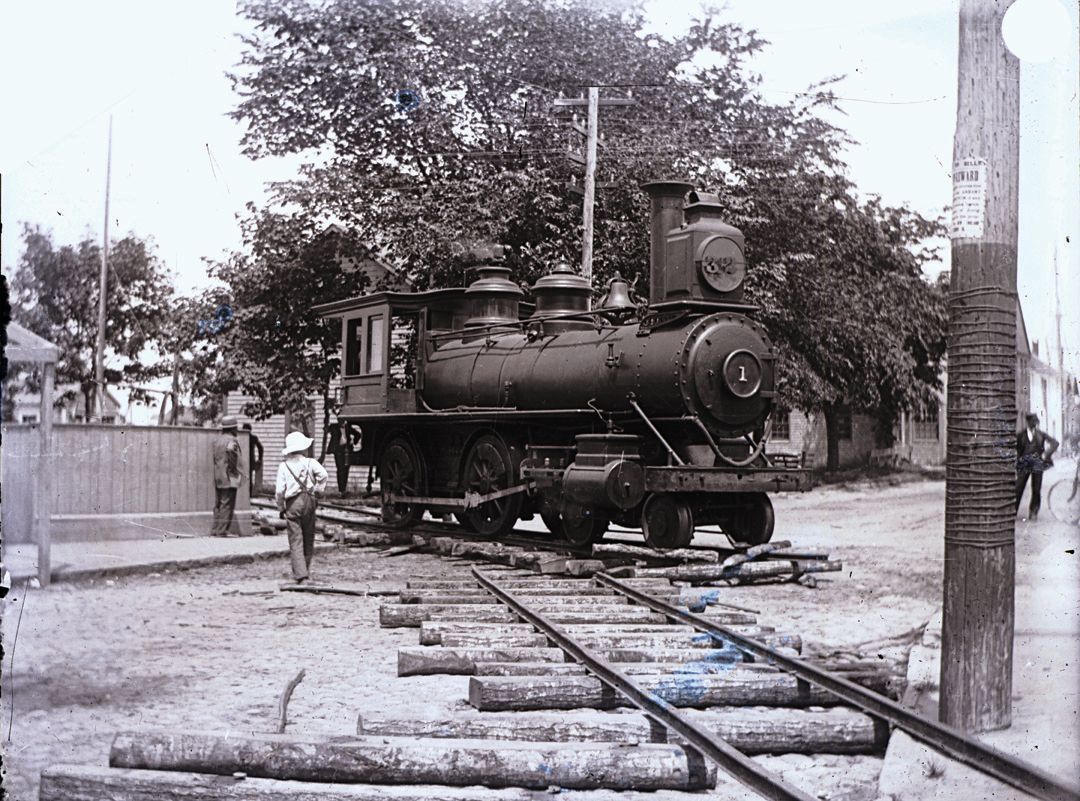
Not much is known about the lost locomotive. Legend has it the massive engine was buried underground after a derailment in one of any number of spots near Orange Street and Washington Street, where the tracks once stood. Other theories suggest the engine was shipped off-island with the rest of the rolling stock, or that it was sent to the scrap heap and sold for parts.
It’s one of the great Nantucket unknowns, one that feels tantalizingly close to being solved. The possibility of a lost piece of Nantucket history sitting six feet under has intrigued Kizilbash for years. His search for the train started, of all places, at the TakeIt-or-Leave-It at the dump. One Saturday, he found a book by island historian Clay Lancaster on the history of the Nantucket Railroad. He became obsessed with the story of the lost train and started combing through estate sales for any piece of the railroad he could get his hands on, piecing together a collection of artifacts that tell the history of the short-lived railroad, which ran for nearly 40 years until 1918.
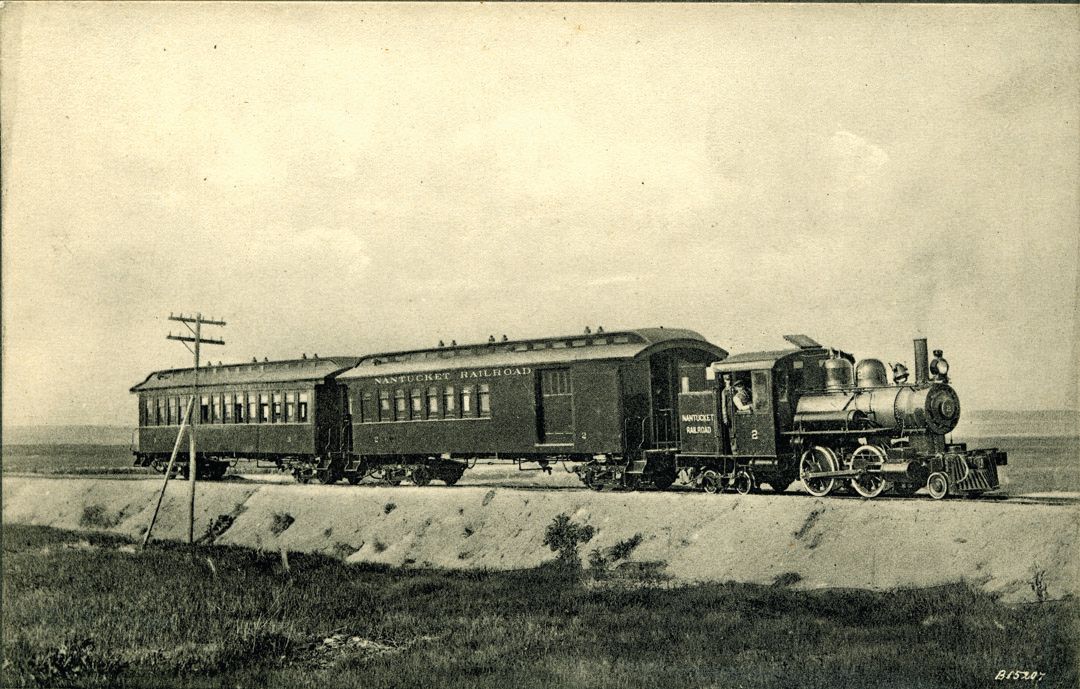
What’s known about the last days of the train comes from the Nantucket Historical Association’s collection, old books at the Atheneum and old Inquirer and Mirror clippings. According to those records, the railroad’s rails, spikes, two passenger cars and an engine dubbed “No. 2” were sent to Bordeaux, France, for the American Expeditionary Forces at the tail end of World War I. There were two other locomotives, called Sconset and Dionis, which had been replaced years earlier. It’s the final resting place of a locomotive called Engine No. 1 that remains unknown. “It’s a game of telephone played over 100 years,” Kizilbash said. “The information was lost in the vapor trail of time.”
Not convinced with the theories that the mystery engine was shipped overseas or to the mainland, Kizilbash started doing his own digging, both physically and metaphorically, around Orange Street and deep into the Atheneum and NHA archives. This fall, he convened a team of archaeologists and metal detectorists to find the train, forming a search party resembling something out of an Indiana Jones movie. “It might take a while, but I’m not going anywhere,” Kizilbash said. “And I’m going to chip away at this until we once and for all determine if it’s buried or not.”

Kizilbash may have struck gold in a 1974 book by Helen Wilson Sherman called A Photographic Journey to Nantucket in 1911. According to Sherman, Nantucket’s Engine No. 1 was “retired in 1910 after having turned over in an accident running off the track and suffered internal injuries.” Eventually, Engine No. 1 was buried “near where Fayette Street runs into Washington Street and no doubt could be dug up if enough present-day buildings were moved.”
Some images from the NHA also show the engine derailed on Washington Street, though it’s possible the train was placed back on the tracks. According to a 1910 Inquirer and Mirror article, derailments “seemed to be almost a daily occurrence, and once or twice in years gone by the locomotive even took a bath in the surf at Low Beach.” But if, as Sherman wrote, the train needed to be replaced, one cheap option would surely be to dig a hole next to the engine and topple it into its final resting place, out of sight, out of mind.
After researching a bit more, Kizilbash narrowed his search to three areas, one on Washington Street—where Sherman said the train was buried—another off Orange Street and a last one near Old North Wharf. “I happen to know not one but two metal detectorists and the head of Columbia University archaeology, who is on the island,” Kizilbash said. “Between the NHA and myself, we have the [engine] bell, the spikes and a [train] ticket. Let’s go get the train.”
On their first reconnaissance mission, the team of Kizilbash and metal detectorists Travis Nichols and Karen Russell didn’t find what they were looking for. But it wasn’t a total waste of time. Instead of a locomotive, they found a 1904 lawnmower part. Kizilbash started thinking that if a hunk of metal from the same decade was discarded in the same general area, it’s a sign that someone might have thought the area suitable to bury something else, something larger.
Solutions like that weren’t uncommon on Nantucket a century ago. According to island historian Nat Philbrick, when people in the early days of automobiles had a car to get rid of, they would wait for Capaum Pond to freeze over, drive to the center of the pond, and wait a few weeks for the melting ice to finish the job. “These Yankees were tighter than bark on a tree,” said Rafael Osona, the auctioneer behind Rafael Osona Auctions. “They weren’t paying anything to throw something away.”
If you ask Osona, an auctioneer with over 40 years of experience on Nantucket, there’s one spot in particular where the locomotive could be. Off Orange Street, across from the Cumberland Farms, there’s a 10-by-20-foot rectangular patch where not much vegetation is growing. “If you get yourself an eightfoot piece of rebar and some boots, you might hit a piece of metal,” Osona said. “The old-timers told me it’s there, guys who are dead now,” Osona added. “I didn’t give a rat’s ass about it back then, but the more I got into this business and inquired why nothing would grow there, it stands to reason that it could be there. If I had to put money on it, I’d bet that it’s there.”
Kizilbash’s team plans to return to that area later this year. The next step, once the team is back together, is to bring in ground-penetrating radar to determine once and for all if they’ve found it. (Ground-penetrating radar has actually been used in the area once before, in 2017, when the town paved a bike path over the former railroad near the Goose Pond. At the time, town transportation planner Mike Burns told The Inquirer and Mirror that they found no train car or engine. But that search was not extensive and stuck close to the rail trail.)
"If it’s underneath a sidewalk or a house, it may be that we come to an official dead end,” Kizilbash said. But if it’s under part of the Land Bank’s Consue Springs property or even the backyard of a cooperative homeowner, the search isn’t over.
If Kizilbash and his crew do find the engine, the 100-ton question becomes what to do with it. “Within the spectrum of things, it’s either that we do what [the Land Bank] did on Easy Street, which is a plaque that gives the history of the railroad, maybe with a QR code that helps spread the information and education around the history of the train,” he said. “The other, more aspirational end, would be to resurrect it. That would be years in the making, and I’m in no rush.”
Of course, there’s a chance the train engine was never buried. There’s also a chance the engine has decayed beyond recognition after a century underground, or that it was buried in an obscure location not on anyone’s radar. But the romance of finding one of Nantucket’s original steam engines is enough to drive people to continue the search. “If after we’re done with all of this, we jump-cut to two years from now and we don’t find it, that would be OK because in the meantime, it wasn’t for lack of effort,” Kizilbash said. “I got to meet amazing people along the way. For me personally, it wouldn’t hit my goal of giving back to the island in a historic preservation way, but it would be OK.”
Latest Stories