Synagogue by the Sea


May 21, 2026

A Look Inside the Last Lifesaving Station

Written by Brian Bushard

Photography by Brian Sager

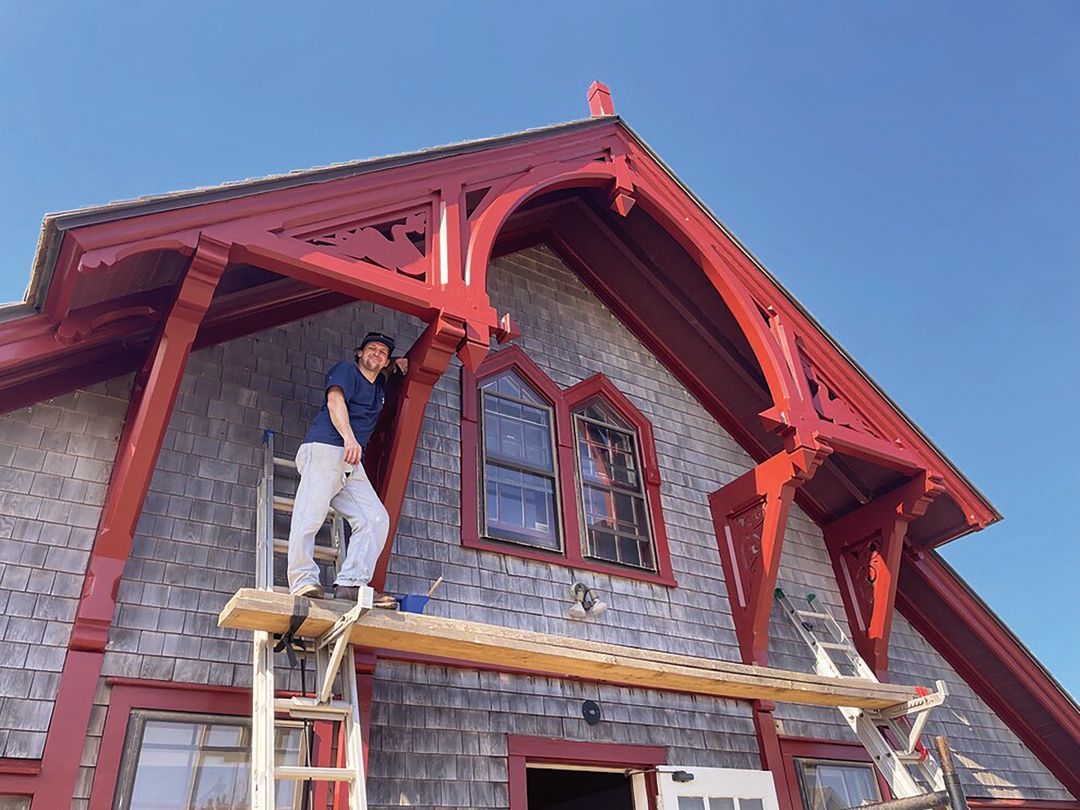
The red gabled Lifesaving Station is like a lens to a previous time on Nantucket. The Gothic-style station was commissioned in 1874 and designed by federal architects on the site of former Humane Society houses, just a few years after developers carved out the area and named it Surfside. At first, the station—iconic with its high steep roofs and observation tower—served as a beacon for mariners battling the dangerous shoals, fog and surf south of the island. Tourists vacationing at the nearby Surfside Hotel—which had only recently been brought over by barge—would watch the surfmen patrol the beach and perform rescue drills as a form of entertainment.


Today, it’s the last of Nantucket’s four lifesaving stations still standing, and one of only a handful of nearly identical buildings left around the country. After serving for decades as a lifesaving station, and then a youth hostel, the historic station had fallen into disrepair, and was one step away from being carved into private lots. Following a tumultuous multi-year bidding war, the building has been restored. Its fate has also been made clear. Under new ownership, the property will soon become the home of Nantucket’s Jewish Congregation Shirat HaYam.


“Something that is historical, that has stood the test of time, that has been so integral inbeing a part of the island and being of service to the island, that’s a sacred space, as well,” said Surfside resident David Gregory, a Shirat HaYam member and former NBC News anchor who purchased the property last fall. “The potential for that as a place of worship struck me. What a great combination of purposes that could serve.”


The building is unique for a number of reasons, including its ornate Gothic style gable roof and its decorative truss work—a combination not seen in many places on the island. Gregory and his wife Beth Wilkinson have always admired the property. “It evokes a different time, it’s such a particular style and it’s endured,” he said.

The couple purchased it for $4.5 million late last year, capping off a six-year period of uncertainty over what would come of the historic building. Egan Maritime Institute had initially tossed its hat in the ring for the former hostel, proposing an exhibition space and educational center that would complement its Shipwreck & Lifesaving Museum. There were also bids from private developers, including Blue Flag Partners, the Boston-based development company run by Nantucket resident Terry Sanford. Blue Flag’s $3.55 million offer beat out a bid from Egan Maritime, where Sanford’s brother, Matt Sanford, served as the president of the board.


Terry Sanford said at the time he envisioned an updated hostel and luxury hotel units on

the property. “From a residential perspective, you could carve this up, and given what’s going on in the residential market, there’s a lot of interest there,” Terry Sanford told The Inquirer and Mirror in 2020. “But it’s not what we’re interested in with the property. I’m not going in that direction."

Blue Flag’s plans never came to fruition. In 2023, the company rented the former hostel to the town for much-needed lifeguard housing. The town even hatched a plan to buy the property for $6 million and use it for employee housing, but the deal was contingent on town meeting support, and voters at the 2024 Annual Town Meeting soundly defeated the measure. With the deal falling apart, Blue Flag announced it would walk away from the property. “Ultimately, we aren’t going to be able to give the Star of the Sea the level of attention that we believe it deserves at this time, so we are seeking a new steward who will carryforward our vision to back the grandeur of this one-of-a-kind property,” the company stated at the time.


Before it sold the property, Blue Flag hired island preservation architect Hollis Webb for extensive renovations to the building. That meant carving white oak in Webb’s shop, replacing old wooden pieces, and repurposing others. “It had been neglected as a youth hostel, but the history of the building itself is really cool,” said Webb, the owner of King Post Preservation, Inc., who led the restoration project. “The ornate gable arch work was obviously collapsing from the street. Once I had an opportunity to work on that building I jumped on it.”


Congregation Shirat HaYam has starteda fundraising campaign for continued renovations to the historic structure to prepare it for use as a synagogue, though with a preservation restriction held by the Nantucket Preservation Trust, no owner of the building can make exterior changes to the structure. Mary Bergman, the outgoing executive director of the Nantucket Preservation Trust, has called the building her favorite of any historic building on Nantucket. It’s just as much a piece of Nantucket’s architecture as a gray shingled house is, she said.“It’s unique now only because we’ve allowed so much of the rest of the island to become so standardized and suburbanized by moving structures to the middle of nonconforming lots,” Bergman said. “Like everything, it’s interesting because of its irregularities and its character."

For Gregory, the purchase marks a new chapter. The Congregation, which was established in 1983, has never had a permanent home, and for years has held services in various places of worship around the island. “The idea of a permanent place to go home really matters for building a sense of community, not just for the Jewish population, but for all of Nantucket,” Gregory said. “In terms of building community and building legacy, itis important for the congregation to know that for the Jewish families that are here in the summer and for a smaller number that are here full time, that there is a place where the community can gather, that there can be events, weddings, prayer, a place for a rabbi or a visiting speaker. It helps fill what the congregation is able to do.”

Latest Stories


By brianbushard August 6, 2026
Written by Brian Bushard Photography by Kit Noble For the past 10 years, Katherine Jetter has been selling her jewelry at her shop on Centre Street, The Vault. But unlike most jewelry stores, she is not only selling her own jewelry, but the earrings, bracelets and rings of 30 other couture jewelers. This month, she is showcasing those jewelers at a residency at Ten Easy Street, which runs through August 15. “The purpose is to celebrate our community and create a place to bring all of our clients into a social environment where they can get to know each other and experience all the things I love and curate on a deeper level in a social environment,” Jetter said. “I love bringing people together and curating, so I have curated some incredible experiences.”  How did you get into the world of jewelry making? I didn’t come from a multi-generational jewelry house where I had the privilege of growing up with a safe full of gems and access to everything. I’m completely self-made, and the only way that I could shine in a very saturated industry was to really teach myself to be an expert on specific subjects, so that I could really come from a place of knowledge. What did that process look like for you? I studied and studied books on the history of jewelry making. I went to every possible trade show I could find. I’ve been going to the Tucson Gem Show since I was 24 years old and I ask 10,000 questions. The thing that really made me learn was that I was never afraid to say what I didn’t know—why is this amethyst a $10 per-carat stone, and why is this amethyst a $200 per-carat stone? I found allies and friends in the industry that would help teach me and educate me. As a young 20-year-old, I found people who loved their craft who were excited to teach a young person what they knew. I would do everything from finding the rock to going to the mines. That is what I think really is different about me. I made it my business to be an expert and to study what I’m selling, so that I’m not just a designer who’s taking pretty objects and putting them together. I’m being very thoughtful about everything from the ground up—where it starts, how it’s made, the engineering of the piece and the execution. When you’re selling a product, if you don’t understand from the ground up the integrity of the piece, it’s a very different sales process than if you’re coming at it from a place of workmanship. Even though I specialize in certain avenues, I also recognize that there’s something for everybody, and if it’s not something that I’m making, I still want to find you. I love doing that; it really is what excites me. I’ve never had an ego around it being my way or the highway. If I don’t make what you’re looking for, I will find the expert that does.
By N Magazine August 4, 2026
FOGGY SHEET
By N Magazine August 4, 2026
FOGGY SHEET
By N Magazine August 4, 2026
FOGGY SHEET
By Paige Martino August 4, 2026
Interview by Paige Martino Photography courtesy of the Nantucket Historical Association Long before Greater Light became one of Nantucket’s most beloved historic houses, it was an aging 18th-century cow barn tucked away on what was then Bull Lane. Where others might have seen a weathered farm building, Quaker sisters Hanna and Gertrude Monaghan envisioned something extraordinary, transforming the humble barn into an exuberant home and art studio layered with salvaged architectural treasures, handcrafted furnishings and original paintings. They called it Greater Light . A hundred years later, Beverly Hall keeps HannaMonaghan’s spirit alive, putting on period clothes and performing as Hanna at Greater Light. “My feeling when I walked inside [Greater Light] for the first time was almost visceral,” Hall said. “One day during the process, I just got so immersed I said, ‘That house just needs someone to bring it alive.’ I just said it. I blurted it out. ‘Someone needs to be Hanna.’ The whole group turned around and said, ‘Beverly, why not you?’” Becoming Hanna meant immersing herself in Hanna’s memoir, filling pages with underlined passages, colorful notes and thoughtful observations tucked into the margins. She interviewed people who had known Hanna and spent countless hours researching both the Monaghan sisters and Greater Light itself. Along the way, she began recognizing unexpected parallels between their lives, particularly in their shared devotion to faith and the arts. “The attraction was immediate,” Hall said. “[Hanna] really sparked something within me, so I took it and ran with it.”
By brianbushard August 3, 2026
Written by Brian Bushard Photography by Kit Noble While they may not be household names in the true Hollywood sense, Nantucket’s summer population includes powerful producers, screenwriters and editors who are behind the scenes on the movies we all recognize. Indeed, Nantucket has an underground entertainment community that is in effect a hidden Hollywood.“I got involved in the Nantucket Film Festival before we bought a house on the island,” said Marc Resteghini, a producer with Amazon MGM Studios who executive produced the series Young Sherlock. “As I started to learn a little bit more about the festival itself, I started to realize there were a lot of people who either lived on the island or vacationed here from the entertainment industry.” Resteghini was named the new chair of the film festival this June. While Nantucket has a reputation for attracting politicians and Wall Street titans, lesser known is the fact that dozens of leaders in the entertainment industry have also found Nantucket as their summer refuge, just not the names you might know. “It’s like Sergeant Pepper Lonely Heart Club Band,” actor John Shea said. “We see each other but the last thing we want to do is talk about the film business. It’s more of a quiet acknowledgement of a fellow traveler thana fellowship.” “The Vineyard is where all the actors and the writers go, the creatives,” documentary film producer Annabelle Dunne added. Dunne summers on Nantucket. “I think a lot of people that work in Hollywood come here to be with their families, relax and enjoy Nantucket, not to network. But it is a small island, and sometimes when you take away the work component and you say we’re just getting together to get together, then things can happen.” 
MORE STORIES