Could Vineyard Wind Become A Turbine Graveyard?
Written by JohnCarl McGrady
Photography by Kit Noble
On April 8, Vineyard Wind issued a warning: Without intervention, the offshore wind developer might be forced to abandon its 62-turbine wind farm southwest of Nantucket, leaving behind what it described as a “dormant wind farm graveyard.” “Vineyard Wind will face imminent and potentially fatal irreparable harm in the absence of an injunction,” the company wrote. GE Renewables (GER), the subsidiary of international energy giant GE Vernova tasked with developing and manufacturing Vineyard Wind’s colossal 800-foot turbines, was threatening to pullout of the project entirely.
Without support from GE Renewables, the project’s “very survival” was threatened, Vineyard Wind claimed in a lawsuit filed this spring. “Only GER is able to perform the remaining work necessary to bring the performance of the GER turbines up to the capacity and reliability standards required for Vineyard Wind to supply power to Massachusetts consumers,” the offshore wind developer stated in the lawsuit. “Even if it were doable, however, it will be virtually impossible to find a turbine supplier that would be willing to take GER’s place.”
For now, a Boston judge has blocked GE Renewables from exiting the project and ordered the energy company to continue fulfilling the terms of its contract with Vineyard Wind while litigation plays out. But if GE Renewables is ultimately able to exit the project, it is unclear what might happen to the wind farm—part of a group of offshore wind farms proposed along the Eastern Seaboard—or to Nantucket.
HOW WE GOT HERE
There is no money set aside to decommission the turbines. The federal government waived the requirement to supply the funds while Vineyard Wind was under construction. At the time, the liability was estimated at $191 million. Five years ago, the American offshore wind industry was booming. Former President Joe Biden had made renewable energy one of the cornerstones of his presidency, handing out large grants and spurring billions of dollars of development off the East Coast.
For proponents, the promise was tantalizing: an endless renewable source of clean energy that could power tens of millions of homes. With this promise on the horizon, the Bureau of Ocean Energy Management granted a waiver of the required decommission funding to “reduce Vineyard Wind’s upfront financial assurance burden, thereby facilitating the Project’s financing process and enabling Vineyard Wind to invest the available capital in planning and construction.”
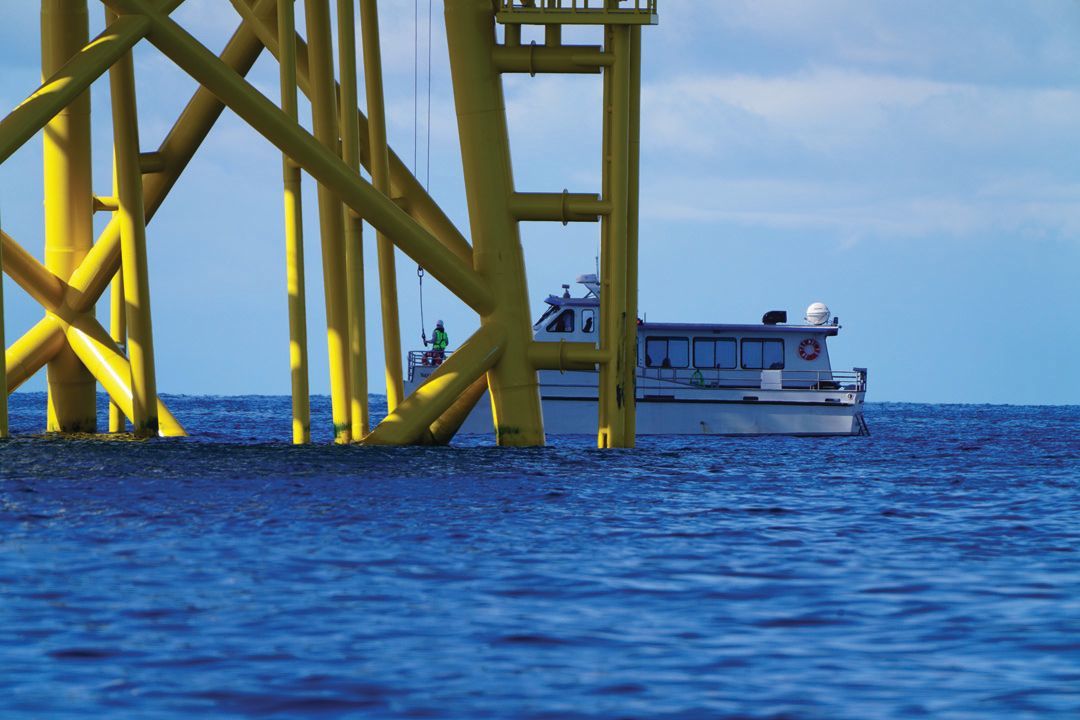
In the waiver, the bureau cited Vineyard Wind’s “robust insurance policies,” use of “proven wind turbine technology” and “predictable income.” “Granting this departure protects the environment, and public health and safety, to the same degree as if there were no approved departure,” the bureau wrote at the time.
Now, the industry is nearly dead. Since returning to office, President Donald Trump has put offshore wind in his crosshairs, reconsidering a slew of permits issued by the Biden administration, stopping wind farms already under construction and stripping funding from related infrastructure projects. The Trump administration characterizes offshore wind very differently, seeing it as an economically inferior impediment to natural gas and oil and a threat to national security.
Meanwhile advocacy groups like Nantucket’s ACK for Whales have slammed the development of offshore wind for environmental reasons. ACK for Whales sees the latest lawsuit filed by Vineyard Wind as an admission of what the organization has argued all along. “This has been an epic fail in all directions,” ACK for Whales representative Amy DiSibio said of Vineyard Wind's lawsuit against GE Renewables.
Facing strong political headwinds, many offshore wind companies have abandoned projects, watched development stall or sold their rights to the large lease areas set aside for wind power back to the federal government, making it a precarious moment for the American offshore wind industry. If Vineyard Wind survives, it could chart a narrow course for offshore wind companies looking to capitalize should a future presidential administration reopen the Atlantic.
If the project is abandoned and the turbines are not torn down, there is always the chance of a collapse, like the blade failure in 2024 that spread debris across Nantucket’s south shore during the peak of the summer. This is one way in which offshore wind differs from onshore wind. At an abandoned wind farm on land, a collapse would likely only affect the installation’s immediate surroundings, but in the water, it’s at the mercy of the currents.
Still, some anti-offshore wind advocates see the project folding as better than the alternative. “I hope that’s the problem we have because that is solvable. This is a problem we can solve. It is better to find out this is a fool’s errand when there are 62 turbines in the ground than when there are more than 1,000,” DiSibio said. “I’m hoping this project fails.”
Vineyard Wind claims GE Renewables owes them over $500 million because of the blade failure, including costs associated with replacing other potentially defective blades, and has been withholding payment to recoup the losses. GE Renewables denies this and says instead that Vineyard Wind owes it more than $300 million in unpaid bills.
“There is no basis for VW’s nonpayment. Among other reasons, GER has supplied VW with replacement blades corresponding to the Removed Blades, so there simply is no legitimate basis on which to offset previously paid amounts,” GE Renewables’ executive project director Sebastian Mertens wrote in a court filing. “In GER’s view, the provision of replacement blades constitutes the contractual remedy for any alleged defects in the Removed Blades.”
So far, the courts have backed Vineyard Wind. Suffolk Superior Court Judge Peter Krupp wrote in his temporary injunction this spring that the contract between the parties indicates that disputes over unpaid funds must be resolved by a project engineer, and that the engineer sided with Vineyard Wind. If the project is ever left behind, however, Nantucket does not have the money set aside to tear the turbines down. Neither does Vineyard Wind or GE Renewables. Instead, the obligation might fall on the state or federal government. Or, more likely, the issue will end up in court.
Latest Stories