Off the Beaten Path


May 22, 2026

Nantucket's En Plein Air Artists

Written by Brian Bushard

Photography by Kit Noble and Brian Sager

llya Kagan’s office for the day is beside the easel he’s set up in the heart of the Middle Moors. Kagan, a plein air painter since 1989, is by himself, watching as the wispy cirrus clouds drift by slowly overhead and the afternoon sunlight turns a warmer shade of orange. Plein air painting, or painting outdoors, a style made famous on Nantucket 100 years ago by landscape artist Frank Swift Chase, is fundamentally a solitary and cerebral experience, Kagan said.


“That’s the nature of plein air,” he said. “When you’re working in the studio, you have all the time in the world to fix things up and move things around, but when you’re en plein air, you’re looking at something, it’s moving and the light is changing on it. It’s like live music versus studio music. Studio[recordings] have a nice finish, but live music has spontaneity that makes it more direct and more interesting."


"You can’t help but change. Change is inevitable,” Kagan added. “When I find myself coming back to the same subject, I’ll try to interpret it the way I did when I was 20 but I’m different now. The way I see darks and lights has changed. James Taylor said that everyone wants to hear him play ‘Fire and Rain,’ but you have to bring something new to it or else it becomes a trope. It’s just the same thing over and over again.”


Kagan is one of dozens of Nantucket painters participating in the Artists Association of Nantucket’s Plein Air Festival this June. Some artists, like Kagan, bring a more traditional perspective to interpreting the natural world around them when they paint outside, giving each painting a unique look while staying true to the familiar surroundings they’re painting. Other artists, like Katherine Miller, take an abstract approach.
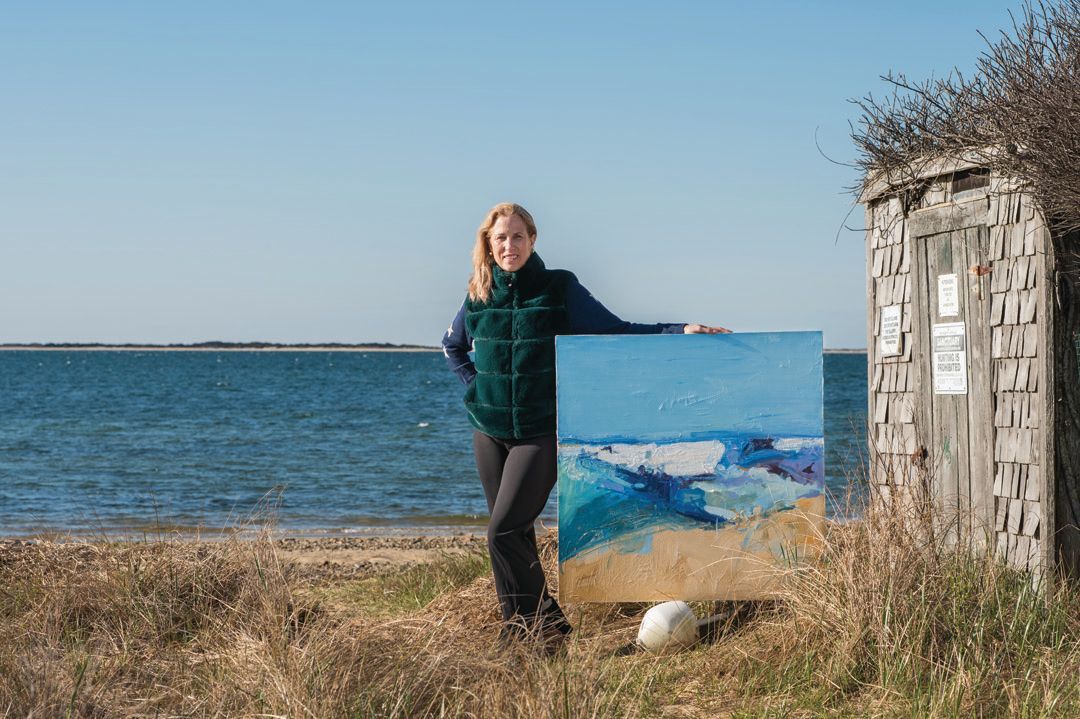
It's not like an anatomy course,” she said about her approach to painting. “It’s not about representing exactly what you see. I never know exactly what the painting will look like. I think I have good intentions about what the painting may look like.” Miller is not technically a plein air artist, though she takes inspiration from the style. Rather than paint outside, she photographs natural landscapes and brings those photos to her studio, blows them up and hangs them on the wall. Then she paints what she sees in those photographs. “It’s almost like an intellectual investigation of the landscape,” she said. “It’s a deconstructed, abstract landscape. They’re still recognizable, but it’s not like looking at a hydrangea.”


In ’Sconset, Marcus Goulding takes inspiration primarily from the historic cottages, vegetation and people in the village. Most of his work is done in the bed of his truck, where he has set up an easel, a canvas and either watercolor or oil paints. A watercolor painter, he pivoted to oils after he found a selection of oil paints at the Take-It-or-Leave-It at the town landfill. “Things just come into my head,” Goulding said. “I’ll suddenly see things in it. I just make a mess of black paint and purple and start to put some other paint in, and it all just seems to grow as I go along. The mind takes over.”
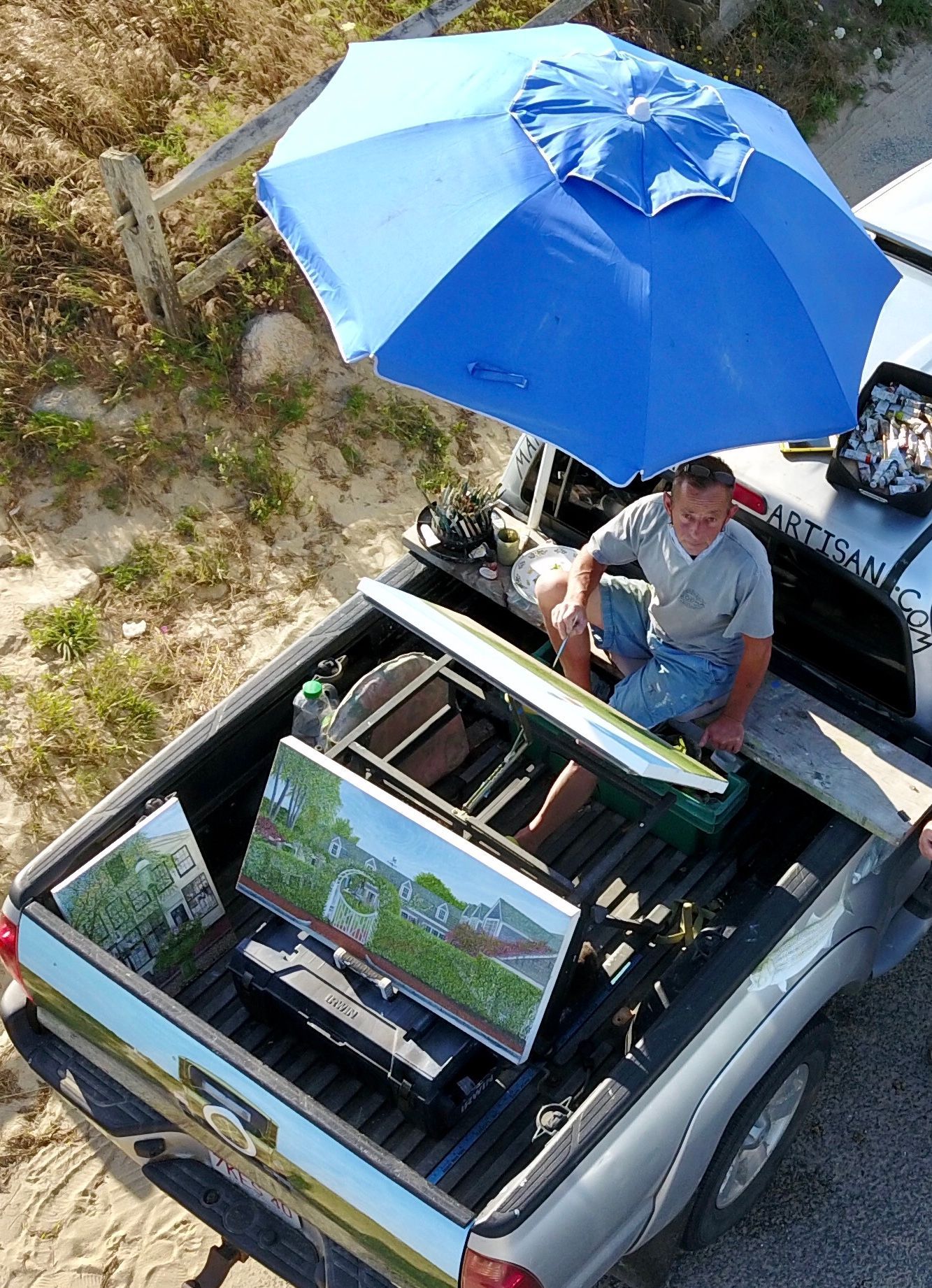
Plein air paintings often take a few weeks to complete. In order to capture the same light and shadows, painters need to be patient, returning to the same light at the same time of day as they started painting. “I was sitting in my truck painting, and my son said to me, ‘Let’s go fishing today. It’s a beautiful day,’” Goulding remembered. “I always feel in my mind that’ll be the one day that someone would have come up for a $10,000 painting. I’m just like that. I just paint and paint and paint and then the end of the summer comes and you think, ‘Wow, I’ve done a lot of painting this summer, probably seven days a week.’”


The 15th annual Plein Air Festival is scheduled for June 12-18 and is free and open for artists of all levels to participate. Freshly painted works will be hung daily for sale at the Cecelia Joyce and Seward Johnson Gallery on Federal Street.

Latest Stories

By brianbushard August 6, 2026
Written by Brian Bushard Photography by Kit Noble For the past 10 years, Katherine Jetter has been selling her jewelry at her shop on Centre Street, The Vault. But unlike most jewelry stores, she is not only selling her own jewelry, but the earrings, bracelets and rings of 30 other couture jewelers. This month, she is showcasing those jewelers at a residency at Ten Easy Street, which runs through August 15. “The purpose is to celebrate our community and create a place to bring all of our clients into a social environment where they can get to know each other and experience all the things I love and curate on a deeper level in a social environment,” Jetter said. “I love bringing people together and curating, so I have curated some incredible experiences.”  How did you get into the world of jewelry making? I didn’t come from a multi-generational jewelry house where I had the privilege of growing up with a safe full of gems and access to everything. I’m completely self-made, and the only way that I could shine in a very saturated industry was to really teach myself to be an expert on specific subjects, so that I could really come from a place of knowledge. What did that process look like for you? I studied and studied books on the history of jewelry making. I went to every possible trade show I could find. I’ve been going to the Tucson Gem Show since I was 24 years old and I ask 10,000 questions. The thing that really made me learn was that I was never afraid to say what I didn’t know—why is this amethyst a $10 per-carat stone, and why is this amethyst a $200 per-carat stone? I found allies and friends in the industry that would help teach me and educate me. As a young 20-year-old, I found people who loved their craft who were excited to teach a young person what they knew. I would do everything from finding the rock to going to the mines. That is what I think really is different about me. I made it my business to be an expert and to study what I’m selling, so that I’m not just a designer who’s taking pretty objects and putting them together. I’m being very thoughtful about everything from the ground up—where it starts, how it’s made, the engineering of the piece and the execution. When you’re selling a product, if you don’t understand from the ground up the integrity of the piece, it’s a very different sales process than if you’re coming at it from a place of workmanship. Even though I specialize in certain avenues, I also recognize that there’s something for everybody, and if it’s not something that I’m making, I still want to find you. I love doing that; it really is what excites me. I’ve never had an ego around it being my way or the highway. If I don’t make what you’re looking for, I will find the expert that does.
By N Magazine August 4, 2026
FOGGY SHEET
By N Magazine August 4, 2026
FOGGY SHEET
By N Magazine August 4, 2026
FOGGY SHEET
By Paige Martino August 4, 2026
Interview by Paige Martino Photography courtesy of the Nantucket Historical Association Long before Greater Light became one of Nantucket’s most beloved historic houses, it was an aging 18th-century cow barn tucked away on what was then Bull Lane. Where others might have seen a weathered farm building, Quaker sisters Hanna and Gertrude Monaghan envisioned something extraordinary, transforming the humble barn into an exuberant home and art studio layered with salvaged architectural treasures, handcrafted furnishings and original paintings. They called it Greater Light . A hundred years later, Beverly Hall keeps HannaMonaghan’s spirit alive, putting on period clothes and performing as Hanna at Greater Light. “My feeling when I walked inside [Greater Light] for the first time was almost visceral,” Hall said. “One day during the process, I just got so immersed I said, ‘That house just needs someone to bring it alive.’ I just said it. I blurted it out. ‘Someone needs to be Hanna.’ The whole group turned around and said, ‘Beverly, why not you?’” Becoming Hanna meant immersing herself in Hanna’s memoir, filling pages with underlined passages, colorful notes and thoughtful observations tucked into the margins. She interviewed people who had known Hanna and spent countless hours researching both the Monaghan sisters and Greater Light itself. Along the way, she began recognizing unexpected parallels between their lives, particularly in their shared devotion to faith and the arts. “The attraction was immediate,” Hall said. “[Hanna] really sparked something within me, so I took it and ran with it.”
By brianbushard August 3, 2026
Written by Brian Bushard Photography by Kit Noble While they may not be household names in the true Hollywood sense, Nantucket’s summer population includes powerful producers, screenwriters and editors who are behind the scenes on the movies we all recognize. Indeed, Nantucket has an underground entertainment community that is in effect a hidden Hollywood.“I got involved in the Nantucket Film Festival before we bought a house on the island,” said Marc Resteghini, a producer with Amazon MGM Studios who executive produced the series Young Sherlock. “As I started to learn a little bit more about the festival itself, I started to realize there were a lot of people who either lived on the island or vacationed here from the entertainment industry.” Resteghini was named the new chair of the film festival this June. While Nantucket has a reputation for attracting politicians and Wall Street titans, lesser known is the fact that dozens of leaders in the entertainment industry have also found Nantucket as their summer refuge, just not the names you might know. “It’s like Sergeant Pepper Lonely Heart Club Band,” actor John Shea said. “We see each other but the last thing we want to do is talk about the film business. It’s more of a quiet acknowledgement of a fellow traveler thana fellowship.” “The Vineyard is where all the actors and the writers go, the creatives,” documentary film producer Annabelle Dunne added. Dunne summers on Nantucket. “I think a lot of people that work in Hollywood come here to be with their families, relax and enjoy Nantucket, not to network. But it is a small island, and sometimes when you take away the work component and you say we’re just getting together to get together, then things can happen.” 
MORE STORIES