Gilding the Lily
The Land Bank restores Lily Pond
Written by Brian Bushard
Photography by Kit Noble
Lily Pond might be the Nantucket Land Bank’s most popular property, but it has also become one of the organization’s biggest environmental problems in its 40-year history. More wetland than true pond, Lily Pond has collected nutrient-heavy stormwater for decades from the surrounding neighborhood, creating a network of invasive species and a perfect habitat for harmful algae as well as a propensity to flood.
This fall, the Land Bank plans to start work on a major project that would restore over 2,500 feet of wetlands and construct another 1,700 feet of wetlands to reduce flooding, improve water quality and make the 6.5-acre public park more accessible. “Lily Pond is one of the earlier purchases for the Land Bank in 1986, and it has historical relevance to the Land Bank itself,” Land Bank Executive Director Rachael Freeman said.
For nearly 10 years, the Land Bank has been brainstorming methods to fix the flooding. Lily Pond sees hundreds of people walking its boardwalks and trails every day. But after any period of significant rain, the park floods, making it nearly inaccessible. And because the one outflow pipe leading to the harbor has long been choked with tree roots and sediment, there’s nowhere for that stormwater runoff to go once it enters the pond, in turn pushing standing water onto neighboring properties.
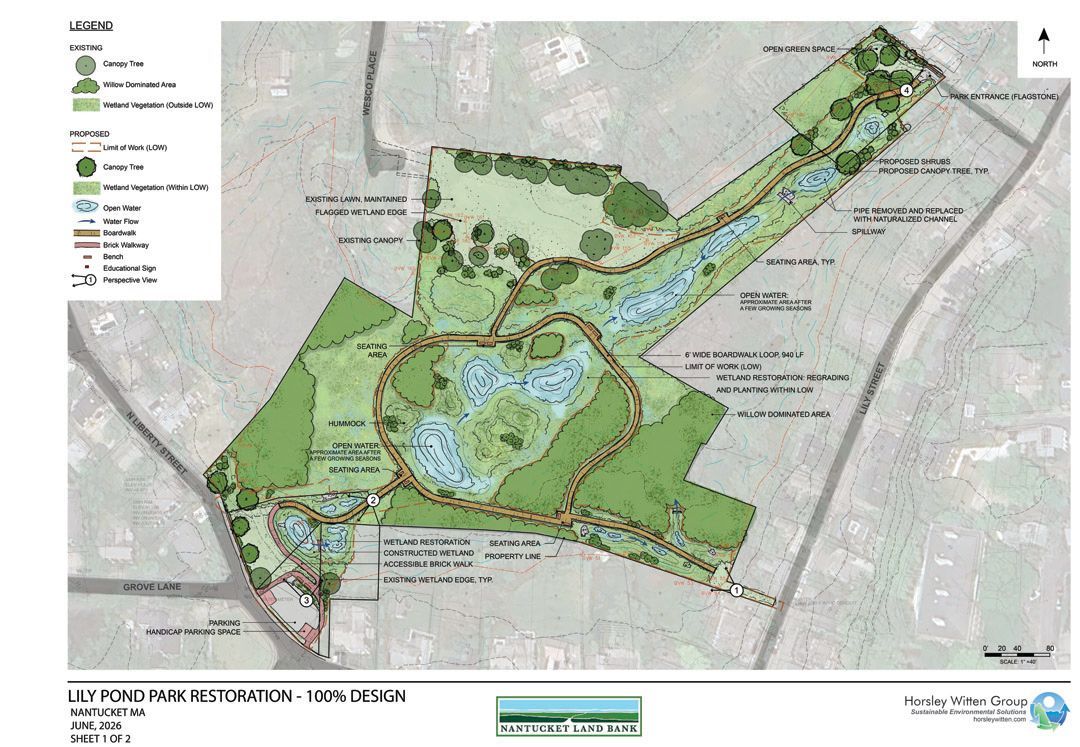
The solution is to have Lily Pond function similarly to a rain garden, which can naturally filter as much nutrient-heavy stormwater runoff as possible through native plants before those nutrients would otherwise enter the harbor or create a harmful algal bloom. The restoration would also improve accessibility through an elongated boardwalk system with seating areas and grassy spots to sit.
“Wetlands are better filtering systems than ponds,” Freeman said. “We know there’s a huge amount of water that comes into this area that needs to be filtered. When you look at ponds that have harmful nutrients coming in, that leads to harmful algal blooms, which could be a problem in this area if we turn it into a pond.”
Those algal blooms have become a major environmental and health concern on the island. The blooms have been found in freshwater bodies across the island and have been associated with health effects like irritation liver damage and intestinal illnesses, and can be deadly to pets. Meanwhile, nitrogen that leaches from fertilizer into the harbor has been blamed for a decline in vegetation, including eelgrass, the primary habitat for Nantucket Bay scallops.
According to the Land Bank, the restoration would improve water quality on more than 1.4 million gallons of stormwater and filter 47 pounds of nitrogen in that stormwater runoff annually. It would also remove invasive phragmites and Japanese knotweed that have spread across the property. “Even though when you walk through there, it certainly looks like a wetland, we all understood it wasn’t what we would consider to be a healthy wetland,” said Brian Kuchar, the principal landscape architect at the Horsley Witten Group, which developed the Lily Pond project. “There was monoculture and not a lot of [plant] diversity. Over time, this area has filled in with invasive plants.”
There have also been discussions about transforming the property into a true pond, which it once was when the English settlers built a dam for a fulling mill roughly where the restaurant American Seasons is located. According to local legend, the pond remained for half a century, until one night in the 1720s, when an 11-year-old girl named Love Paddock dug a small trench along the dam to watch the water trickle out. When she returned the next morning, the trickle had grown into a torrent of water cascading out of the pond, flooding properties and damaging boats out to the harbor. She only confessed to emptying the pond on her death bed.
Today, however, the tide has turned on the idea to recreate the pond. “We looked at whether we could create more open water,” Kuchar said. “[By creating a pond], you would change the aesthetic, but you would also change the ecology of this area. From a permitting standpoint, that becomes a much greater challenge because you would be losing wetland. Wetlands are one of our most valuable natural resources, and from a state perspective, the state is trying to increase wetlands.”
Freeman agreed. “One of the things we recognize is that this is a property people like the way it is. We have Land Bank properties we’re focusing on improving in subtle ways environmentally and for the public because people love them just the way they are,” she said. “The biggest change you’ll see visually is that it will be completely accessible. There will be a trail that goes through the whole park. That’s a big shift and it’s very beneficial because all users can use the space. Part of our goal is to not change it, interestingly enough, not changing the core but maintaining what people love about it."
Latest Stories