Maintaining a Healthy Harbor
The Great Harbor Yacht Club Foundation invests in Nantucket Harbor
Written by Brian Bushard
Photography by Kit Noble
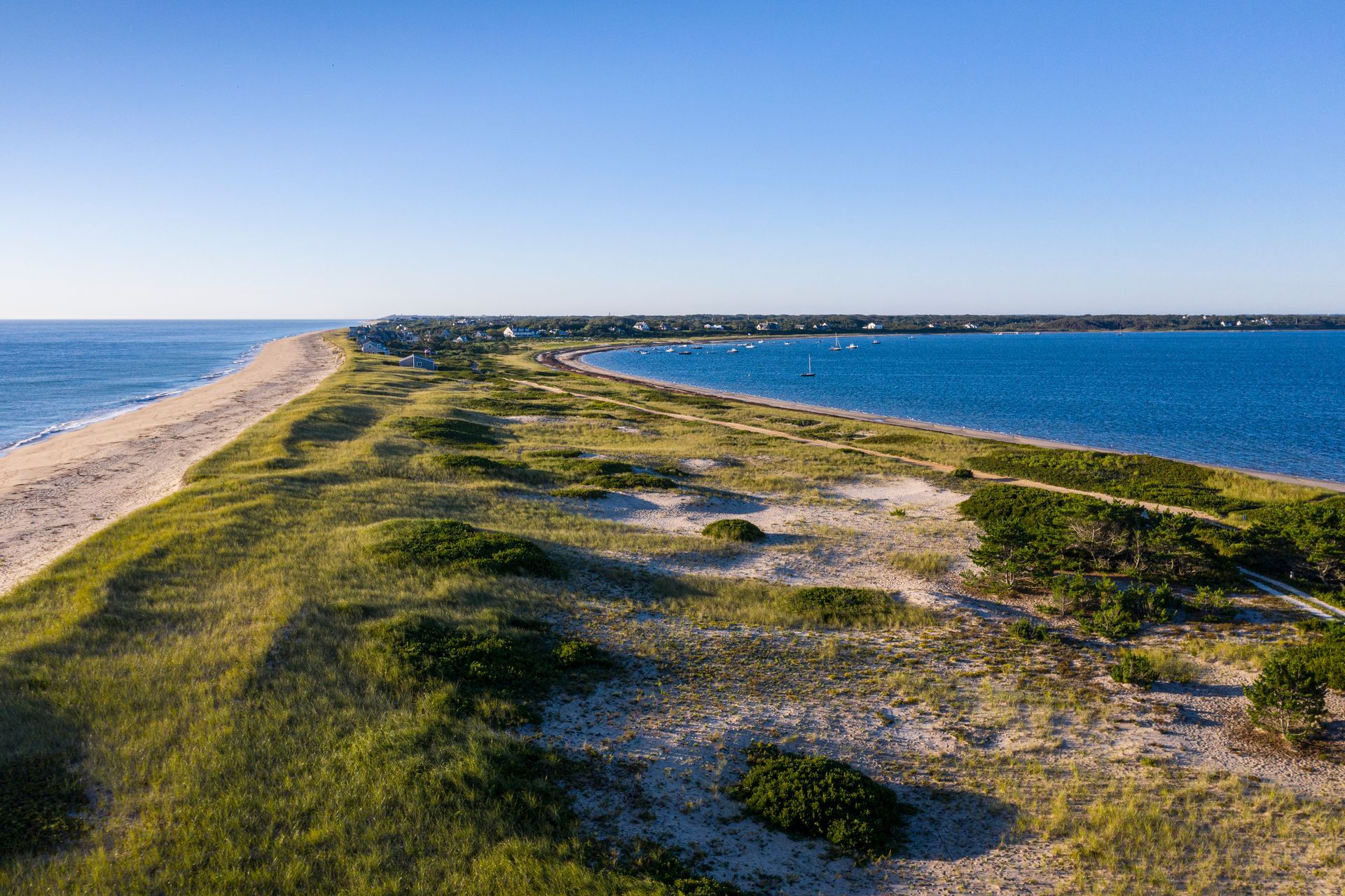
While there are many issues that face Nantucket, few are as threatening as the potential breach of the Haulover on the east end of Nantucket Harbor. As stronger storms and sea-level rise batter the east end of the island, researchers are concerned the harbor could break open to the ocean, creating a flow of water through the harbor and putting at risk virtually every house from Wauwinet to Brant Point.
“Ultimately, we certainly want to help be part of the solution. It’s going to be a big number [in funding], so there will need to be island-wide [planning],” said Ed Orenstein, president of the Great Harbor Yacht Club Foundation. Since the yacht club launched its charitable foundation in 2018, it has dedicated over $1.5 million to more than 60 projects to protect the harbor, including on the fragile barrier beaches of Coatue and Coskata.
The funding comes at a critical time. By 2100, moderate sea-level rise projections show that 89% of Coatue’s beaches and 70% of its dunes will be submerged. As a barrier beach, Coatue and Coskata form a natural shield for the entire harbor from pounding waves in tropical storms and Nor’Easters. But those very waves now chip away at those protective dunes on Coatue, which stand just six feet above sea level at their highest point. Just last winter, the Galls—the narrow stretch up to Great Point—experienced two washover events, when waves carried all the way over the beach.
“Barrier beach systems have always been dynamic,” Trustees President and CEO Katie Theoharides said. “What’s changing now is that erosion is accelerating so much. Coupled with sea-level rise and storm surge, that natural process is being accelerated so much that the systems can't keep accreting at the pace they need to keep pace with."
Coastal resilience has increasingly become a top priority for not just homeowners along the harbor and the Great Harbor Yacht Club, but the town of Nantucket, the Steamship Authority and Hy-Line Cruises. Earlier this year, town officials heard proposals to lift the harbor bulkhead and raise Easy Street, which saw water rise to the road level 84 times last year, according to the National Oceanic and Atmospheric Administration.
According to the town’s Coastal Resilience Plan, by2050, Nantucket could lose nearly 569 acres of high saltmarsh, an area 11 times bigger than Boston Common. Projections show a 10-year storm would flood as many as 1,436 structures and 69 miles of roadway on the island. A 100-year storm would flood up to 1,932 structures and 95 miles of roadway. At the Haulover and Coskata Pond, the Trustees and the Nantucket Conservation Foundation—working with a grant from the Great Harbor Yacht Club Foundation—are proposing a solution called a living shoreline to keep erosion at bay on the barrier beach. With a living shoreline, installations like oyster reefs would both protect the beach from erosion and improve water quality by naturally filtering nutrients.
The organizations have also contracted with GZA Geo Environmental Inc. for a LiDAR topographical survey of low-lying areas that will reveal other risk areas along Coatue.
Along with funding for work to preserve the barrier beach, the foundation has also pledged a matching grant to the town’s Natural Resources Department and Harbormaster for two new vessels, and has supported the Nantucket Boys & Girls Club and Nantucket Community Sailing in creating educational initiatives designed to instill in young islanders a drive to protect the harbor.
The foundation has also supported an ocean acidification buoy monitoring system with the Maria Mitchell Association, an eelgrass management plan with the University of Massachusetts Boston, the town of Nantucket and the Nantucket Land & Water Council, and has helped fund the Land & Water Council’s pilot program to replace traditional moorings with an alternative designed not to scour eelgrass on the harbor floor.
All of those projects, when put together, might not protect the harbor forever but can at least start to turn the tide. It’s a simple equation. “Without a thriving, healthy, beautiful harbor, there’s no Great Harbor Yacht Club,” said Christine Bell, executive director of the Great Harbor Yacht Club Foundation. “The goal is to make the harbor more accessible to the broader community and to preserve it,” she added. “[The goal is] preserving that for generations to come. The board and the members of the club appreciate how lucky they are to have this resource that’s not accessible for most of the [United States] population, so how do we share that and help preserve it?”
Latest Stories