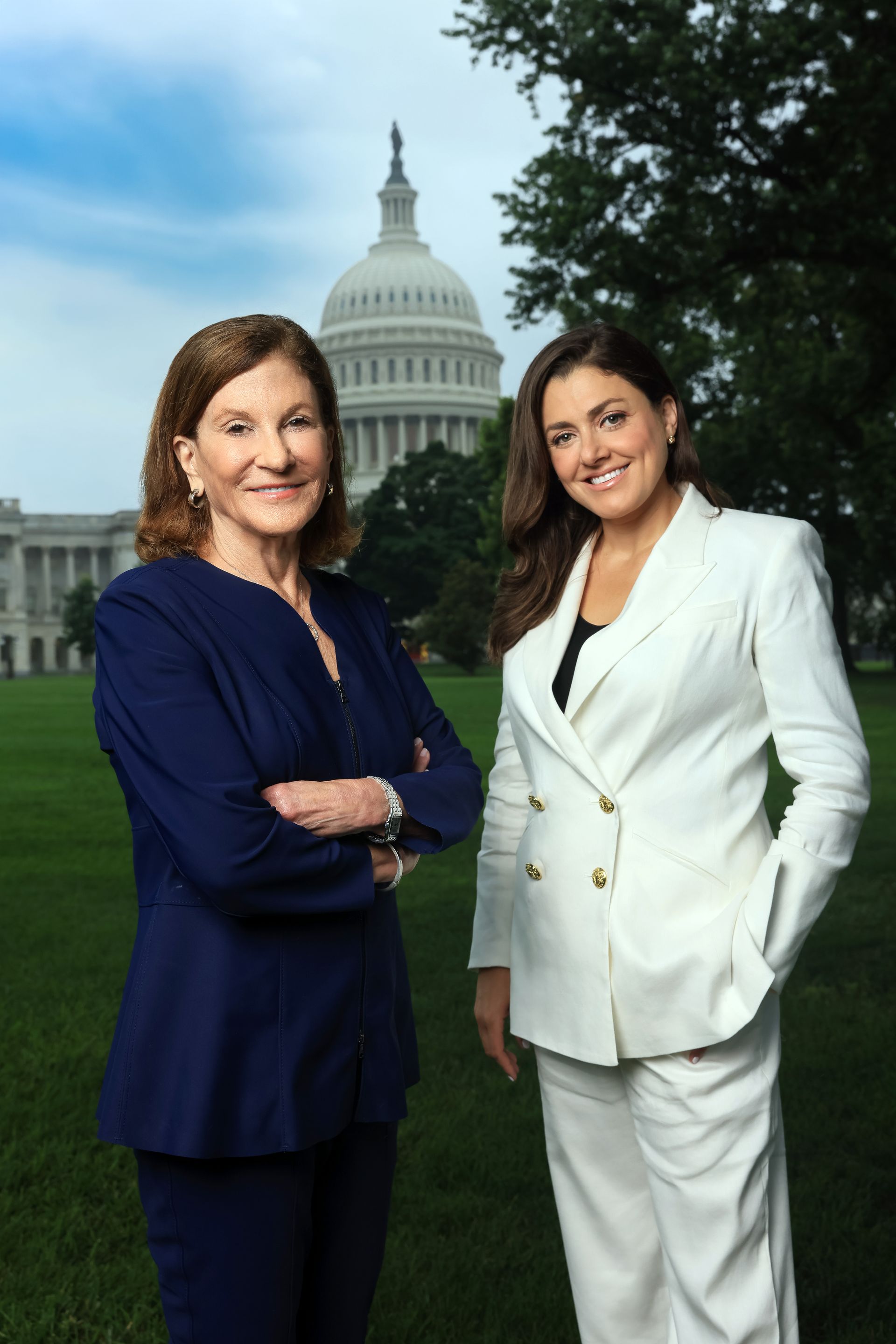
Like mother, like daughter. As a longtime reporter and columnist with The Washington Post, Lois Romano has covered seven presidential races. She has sat down with hundreds of politicians, candidates and journalists. Some of them were invited over for dinner, where they met her young daughter Kristen. Fast-forward to today and Kristen Holmes is now serving as CNN’s senior White House correspondent, while Romano has just published a
New York Times bestseller,
An Inconvenient Widow: The Torment, Trial and Triumph of Mary Todd Lincoln. Romano and Holmes, who spend their summers on Nantucket, sat down with
N Magazine
to discuss what’s happening behind the scenes at the White House, the future of journalism and how politics runs in the family.
To an outside observer, either a journalist is in President Trump’s good graces or they’re not. How do you navigate the need to know with the need to be able to interact with the president?
HOLMES: It’s all about doing our job, and that’s the baseline of everything we do when we enter the White House. The truth is that sometimes you don’t know what you’re going to get when you go into the Oval Office or what mood the president will be in, but you have to ask the questions. The job of a White House reporter is holding the administration accountable. The president loves the media. The president is one of the most accessible presidents in terms of bringing reporters in and answering questions on a regular basis. Reporters can also pick up the phone and call him and he’ll answer. He knows that the media is an important part of his job.
Our job is to do what we do. There are times when I’ve gone into the Oval Office and he has attacked me but still answered my questions. That’s all you can do when you’re in that kind of position.
There has been a long history in presidential coverage of deference to presidents’ health. Is there an unwritten rule not to dig deep on a president’s health?
HOLMES: When there is something, like the bruise on his hand, that’s something we’ve reported out. It’s interesting because there have been reporters who have tried to figure out what exactly, if anything, is going on with his health. It’s not as though we’re not aggressively asking, but we’re getting the same answers in terms of him talking about the aspirin regimen or the bruising. It is also true that it’s not always going to be the first question because we’re in the middle of a war with Iran. There’s news of the day and he’s a man who makes an incredible amount of news.
With respect to Iran, the president was hoping that the overwhelming show of force would yield a quick outcome, which has not happened. Has he acknowledged that he made a miscalculation?
HOLMES: I don’t think he would acknowledge even to his closest advisors that he made a mistake. However, what has happened in Iran and the way this has unfolded has been a driver for everything he has been doing—when you see him laughing over it, the rhetoric he’s used, yelling at people in the media about stories. It is clear tome from the people I’ve talked to who are close to him, that this obviously went way further than he expected it to. He is incredibly frustrated behind the scenes that it’s not over yet. There’s not one person in the White House that would tell you that this went the way they had planned it to go.
We heard [Trump] saying “two to three weeks,” and we’re months into this. There has been a ceasefire, but there’s no official peace deal. That’s something they’re still negotiating and we saw one week ago the exchange of fire. As far as I can tell, President Trump has no interest in going back to a military posture in Iran. He knows how bad this has been for him politically and he wants to be talking about other stuff, as well as seeing a change in the market and affordability. The Iran War was obviously a step back to the price of oil. He needs those prices to go down because that’s one of the big things [he] was touting ahead of the Midterms.
The landscape for journalists has changed so fundamentally in recent years, with national publications turning heavily to social media and developing an online presence. Has your approach as reporters changed?
ROMANO: Pretty dramatically. It’s night and day. I never had the pressures that Kristen has. This 24-hour news cycle is not just breaking news every five seconds; it’s getting it up on every social media platform. I never had those kinds of pressures. You had a couple of news cycles a day, you did the story, you would assume it was accurate and then you would move on. In addition to the 24/7 news cycle and all the social media platforms, you have a lot of people- parachuting in that think they’re journalists.
It’s incumbent upon younger journalists like Kristen who have to go through all this stuff that they’re getting and make sure it’s accurate. It’s coming at them so fast and in so many different sizes, and there’s a lot of misinformation and disinformation coming from everywhere. Being a journalist today is a very, very hard job.
HOLMES: We’re seeing it across the entire board. We’re seeing this investment in vertical videos and social media. The way that people consume news is changing, and we are all working to keep up with this very fast-paced environment. The news industry has gone through this before. They went through it with the invention of the internet. They have gone through it with the addition of email and cellphones. [Journalism] has continued to change, and it will continue to change. So many platforms, from television to online to streaming—we’re constantly growing. That just means that the product that we’re putting out is going to change, not in the substance but in how it’s consumed and how we package it for a modern-day audience.
How do you combat onlinemisinformation?
HOLMES: It requires an enormous amount of researching and reaching out to as many people as you can to try to get a full picture. Obviously, misinformation or disinformation makes everybody’s job harder, because you have to first run down if [a news tip] is true before you then start to try to confirm it or look into what it is. AI is something that has really added to that. Just an example is that President Trump [recently] posted a photo of the South Lawn with this giant emblem on it, and the first thing we had to do was figure out if this was an AI image or if he had actually done it, and it turns out it was an AI-generated image.
The question is whether your life is better now than it was four years ago. How will that impact the Midterms?
HOLMES: That is going to be a huge issue for Republicans and for the president. Right now, polling shows that people feel as though they’re not in a good place financially and they cannot afford to live. Affordability is the number-one issue. That’s a big reason why President Trump won in 2024, because people were feeling that way under Biden. People are still feeling that way, and if [Republicans] can’t figure out their messaging and how to bring the crisis down, then they’re going to have huge issues when people go to the polls.
Kristen, you had a unique insight into Washington, D.C., growing up. Did you always know that you wanted to get into journalism?
HOLMES: No, but I did always know that I loved news, current events and politics. I like to say that there are people who take longer to figure out what they want to do, and I was definitely one of those people. My mom had this amazing, successful career, and when I was going to college, I just couldn’t decide what I wanted to study. One of the things that I had always loved was politics, political science and national events, and I was really good at speech and debate. My mom had suggested that I marry those two things, so I looked into TV news, which, of course, was not the same kind of thing that she was doing at the time. She had been writing for The Washington Post. I thought, “You know what, why not try it?” Over the past two decades, I have grown to just think that this is the perfect job for me, and [my mom] was right about it.
As two women in leadership positions in a traditionally male-dominated field, what impact do you hope you have as a mother-daughter tandem in such a high-profile area?
HOLMES: I do think things have significantly changed since my mom was in this field. For her, she really had to fight tooth and nail, in part because she was a woman, for everything that she did. It was rare for women to be as ambitious. There was a lot that was put on her to try to be one of the guys in a field that was traditionally male dominated. One thing that I hope personally to bring to journalism—but also to women my age who want to have careers—is this idea that we should be able to embrace the fact that we are women and that we bring a unique perspective and a different view than other people do.
ROMANO: The one thing I see more of today, which I think is so healthy, is women helping women. When I was coming up, I didn’t feel like I had that many burdens, but there weren’t that many of us and I was standing on other people’s shoulders. There was a tendency for women not to help each other as much, because they looked at it as a zero-sum game. What I see happening today, which is very heartening, is more of a team spirit. I see women helping other women and wanting their friends and their colleagues to do well. That is a change from 30 to 40 years ago, and it’s a really welcome change.
Do you and your mother disagree onanything politically?
HOLMES: I truly feel that I come into my job from a neutral position, which you have to have. I actively work to see all sides of an issue and tell the news as straightforward as I possibly can. My mom was a journalist for a long time and retired from that industry. She has posted a lot of her opinions online and I don’t always agree with the decision to post your opinions. But that’s where it lands, and I just do my job.
It doesn't take a lot of digging to find criticism of President Trump. What do you find most appealing about your interactions with him?
HOLMES: Every day, I get the opportunity to walk into the White House and potentially get to ask the president a question. I do think that he is the most accessible president in modern history.